

Specialized German stamp varieties (1872–1945)
Explore the fascinating realm of German philately from the founding of the German Empire through 1945. Discover how tiny plate flaws, subtle shade distinctions, distinct perforations, and genuine contemporary cancellations can transform an everyday, penny-box stamp into a major philatelic treasure with substantial Michel catalogue value.

Section One
1872-1874
The Breast shields
In January 1872, the German Empire issued its first adhesive postage stamps.
These stamps were typographed in a range of colours and featured an embossed Imperial Eagle and Shield at their centre.
In June 1872, a revised design was introduced with a larger Eagle and Shield.
These two designs are known as the “Small Shield” and “Large Shield” issues.
Although the design appears simple, there is much to discover.
The embossing on these first German Empire stamps ranges from very strong to extremely faint.
On used examples, a circular date stamp may obscure the shield portion of the embossed design.
Figure 1 illustrates the types of embossed eagles found on the 1872–1874 postage stamps.
Figures 2 and 3 show the actual small and large breast shields.
Two series of these German Empire stamps were issued.
One was denominated in GROSCHEN for use in the North German states, while the other was denominated in KREUZER for use in the South German states.
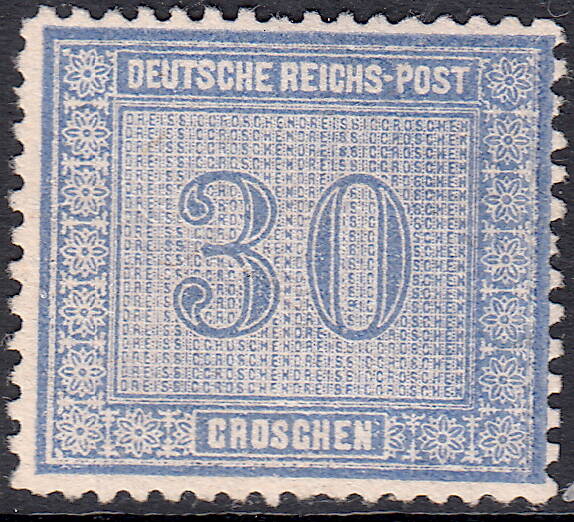
Two high-value stamps were also issued in 1872: the 10 and 30 Groschen denominations. These were typographed and featured large numerals of value in the centre. An example is shown in Figure 4.
For a comprehensive overview, see my Stampboards thread: https://www.stampboards.com/viewtopic.php?t=92119
The Michel catalogue covering the period 1872–1945 is available in English.
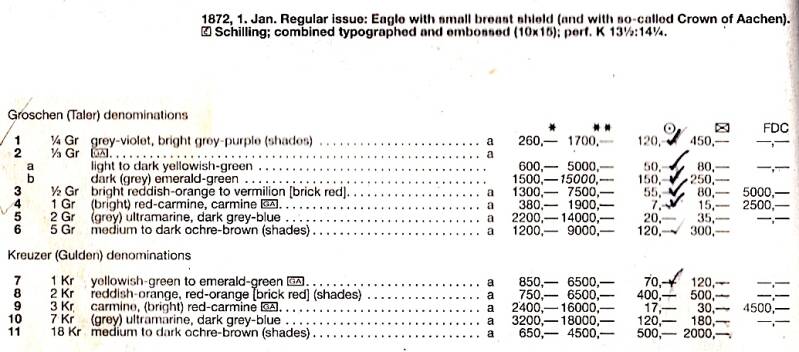
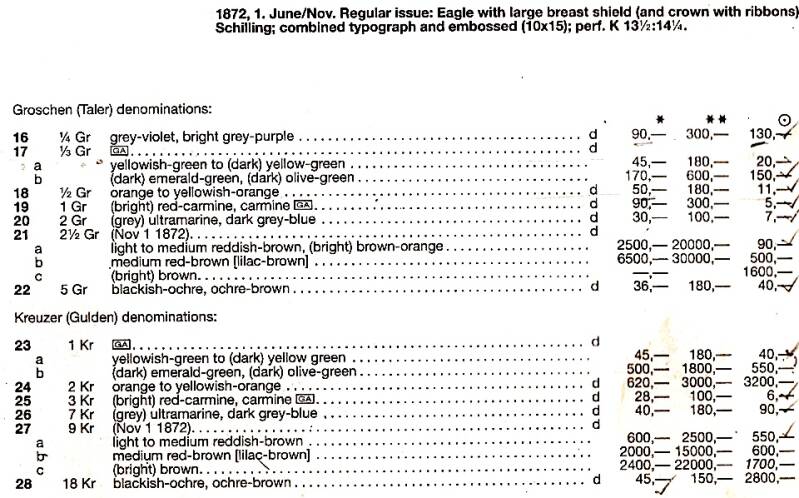
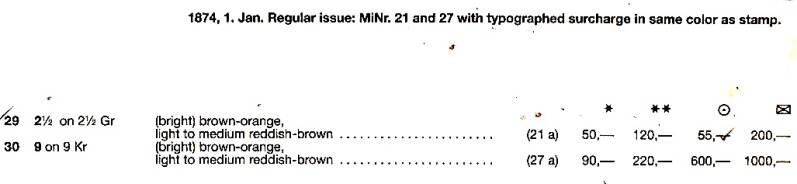
For readers without access to a Michel catalogue, I have included the Michel tables in Figures 5–9.
These cover the breast shield issues from Michel (hereafter Mi.) 1 to 30.
One star indicates mint hinged, two stars indicate mint never hinged, and a circle with a dot indicates cancelled.
The letter symbol denotes a stamp on letter, while FDC means First Day Cover. Values are shown in euros.
It is important to note that many genuine stamps, whether mint or cancelled, have high catalogue values in their own right, even before variants are considered.
In general, genuinely cancelled stamps (geprüft in German) carry the highest catalogue values, although this is not always the case and reference to Michel is essential.
Today, expert certification is often the highest required standard of proof.
Figures 10 and 11 show most of the examples listed in Michel.
A note on mint and cancelled stamps
Michel values never-hinged mint (MNH) examples with original gum considerably higher than mint hinged (MH) examples. This is common in German philately and is largely driven by collector demand.
Shades
Shade differences occur with 2a, 2b, 17a, 17b, and 21a, 21b and 21c, where the shade can dramatically affect the catalogue value. After overall condition, this is the first factor to consider when assessing a stamp.
Condition
These are old stamps, and many cancelled examples are in poor condition, with thins, faults and missing perforations. Such defects can drastically affect catalogue value. Mint stamps are generally in better condition, but many have been hinged and may have thins caused by hinge removal, as well as disturbed or affected gum. A genuine find is a mint never-hinged example with original gum, as many stamps have been regummed.
Stanley Gibbons (SG) catalogue values
It is interesting to note that Stanley Gibbons takes a different approach to catalogue values.
It uses only mint and used classifications, with mint values generally far exceeding those for used stamps.
It also recognises far fewer shades than Michel, as shown in Figure 12.
Please forgive the spelling error: BISTER should read BISTRE.
A range of mint stamps is shown in Figure 13.
Cancellations
Another important area when identifying scarcity is the cancellation on a stamp.
Of particular interest are horseshoe cancellations. These are often assigned strong catalogue values, especially on postal history items such as postcards and letters.
The “horseshoe cancel” (Hufeisenstempel in German) is a distinctive type of postal cancellation used in the North German Confederation and, later, the German Empire. It was introduced in April 1864 and remained in use until approximately 1900.
As its name suggests, the cancellation resembles a horseshoe. It typically includes a town name together with numerals, stars or other identifiers,,
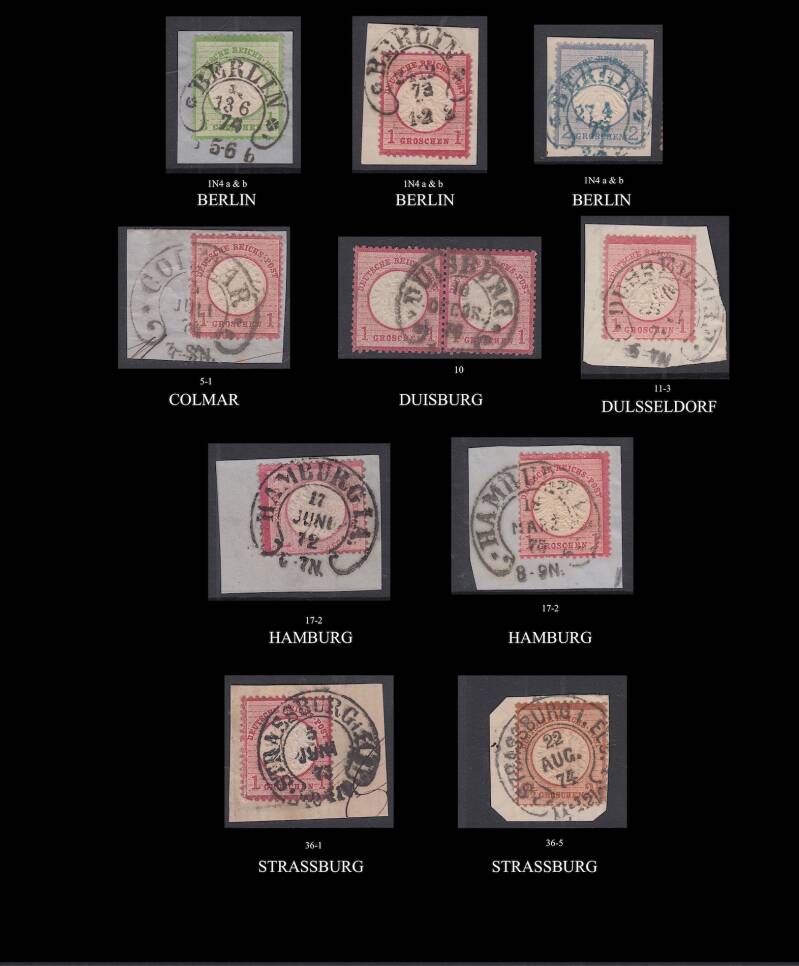
14. Examples of Hufeisenstempel ( horseshoe cancels).
Perforation differences
The 1872-74 have do have difffences in perforations that slightly increase their ´value`.
Here is an overview.
Perforates are counted vertically.
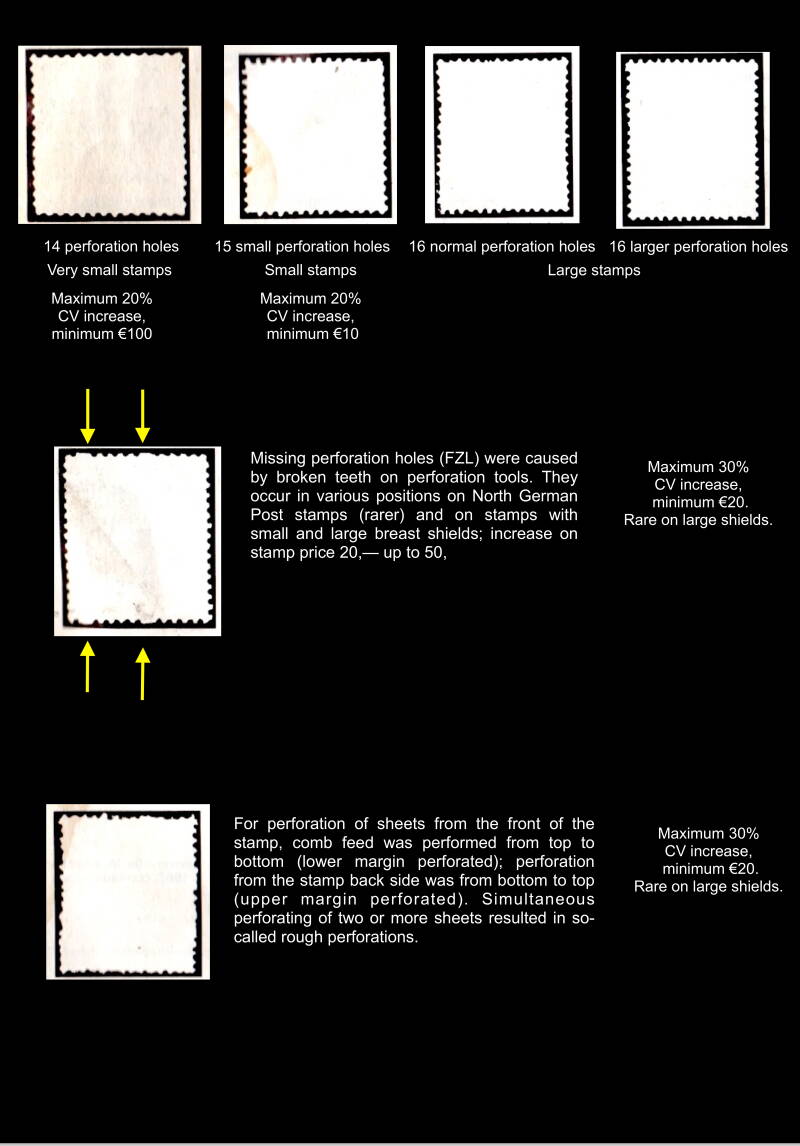
Now it is time to look for flaws.
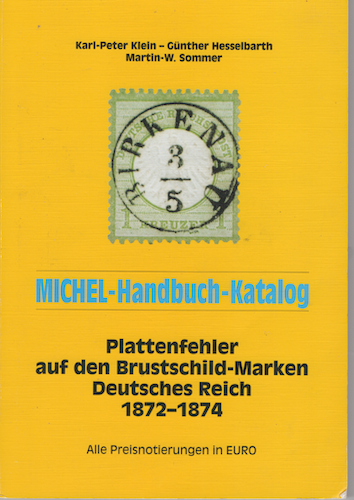
An essential reference guide is shown in Figure 15.
Although it is written in German, scanning and translating the pages of interest is not particularly difficult.
This is true of many of the guides needed to identify flaws, reflecting the depth of German expertise in these areas.
The handbook covers hundreds of flaws found on the 1872–74 stamps and provides catalogue value (CV) estimates.
It is well worth the investment.
An example page is shown in Figure 16, with its translation in Figure 17.
Figure 18 shows a flaw on one of my own stamps showing high CV of €250 as combared to a normal stamp of €7.
Some flaws are scarce and command high CVs, particularly when found on stamps that already have a high CV.
Other flaws can increase the value of a stamp from around €1 to €25–€100. In realistic selling terms, this may mean an increase from almost nothing to €5–€20.
For this reason, you need a good number of stamps to examine.
Naturally, stamps with high CVs are difficult to acquire in bulk because of their inherent cost. Lower-CV stamps, however, are relatively easy to obtain in large quantities.
First, check what you already have. You may then wish to take a chance on buying additional lower-CV stamps in bulk to search for flaws.
What do I mean by low-CV stamps?
Note the relatively low CVs for cancelled Mi. 4, 9, 17a, 18, 19, 20, 22 and 23.
These stamps can be obtained in good numbers and examined for flaws. Indeed, I have uncovered many flaws from such sources.
In the next section, we will look at the flaws I have identified.
stampboards.com information
Here is a list of the German oriented threads available on stampboards.com
I am johnrcrow
Some excellent information available a ´click`away.
johnrcrow inputs
1. Detailed look at my German Postage stamps 1923 to 1945.
https://www.stampboards.com/viewtopic.php?p=4140421#p4140421
2. Danzig Postage Stamps 1920 to 1939: a detailed discussion.
https://www.stampboards.com/viewtopic.php?f=13&t=49505
3. "Basket" Printing flaws on the German Inflation era stamps.
https://www.stampboards.com/viewtopic.php?f=17&t=34518
4. Germany: plate flaws of 1889 Krone/Adler 10 Pfennig issues.
https://www.stampboards.com/viewtopic.php?f=13&t=51082
5. Detailed look at German Reich 1M to 5M 1900 to 1920.
https://www.stampboards.com/viewtopic.php?f=17&t=60701
6. Detailed look at my German Official stamps 1903-1944.
https://www.stampboards.com/viewtopic.php?f=17&t=83365
7. Germany 1875 to 1900 stamps - perforation & paper varIants.
https://www.stampboards.com/viewtopic.php?f=17&t=82738
8. Detailed look at my 1945 Berlin & Brandenburg postage stamps.
https://www.stampboards.com/viewtopic.php?f=17&t=86850
9. Detailed look at my Berlin PO numbered cancels 1875-1920´s.
https://www.stampboards.com/viewtopic.php?f=17&t=74509
10. A look at Germany Weimar III Reich 1923 to 1945 flaws.
https://www.stampboards.com/viewtopic.php?f=17&t=87407
11. Detailed look at my German Empire stamps 1875 to 1900.
https://www.stampboards.com/viewtopic.php?f=17&t=67110
12. My Germany 1920 overprinted ´Farewell Series`stamps.
https://www.stampboards.com/viewtopic.php?f=17&t=86972
13. A look at my Germany 1922 Michel 233 & 234 Plate flaws.
https://www.stampboards.com/viewtopic.php?f=17&t=86094
14. Detailed look at Germania Issues 1900 to 1922.
https://www.stampboards.com/viewtopic.php?f=10&t=74927
15. My Germany 19th century local issues postage stamps.
ttps://www.stampboards.com/viewtopic.php?f=17&t=85482
16. 1914-1918 German Occupation overprint stamps from Europe.
https://www.stampboards.com/viewtopic.php?f=13&t=48716
17. Saar & Saargebiet stamps 1920-1935. A detailed discussion.
https://www.stampboards.com/viewtopic.php?f=13&t=48810
18. Detailed look at my Joint Issues US, Sov & Br. Zones 1946-48.
https://www.stampboards.com/viewtopic.php?f=17&t=74079
19. Germany. My Russian Zone SG catalogue defined pages.
https://www.stampboards.com/viewtopic.php?f=13&t=91447
20. Detailed look at my German Inflation era Postage Stamps.
https://www.stampboards.com/viewtopic.php?f=17&t=60435
21. GERMANY: Stanley Gibbons and Michel cataloguing comparisons.
https://www.stampboards.com/viewtopic.php?f=13&t=88723
22. Structures series of American & British Zone Germany 1948/52.
https://www.stampboards.com/viewtopic.php?f=17&t=84054
23. Hamburg - Institute Boten stamps mainly forgeries sold.
https://stampboards.com/viewtopic.php?f=13&t=48946&hilit=Boten
24. SAAR imperforated high values, more info needed?
https://www.stampboards.com/viewtopic.php?f=10&t=38710
25. Examination of German Empire 1872-1874 postage stamps.
https://www.stampboards.com/viewtopic.php?f=17&t=92119
26. Cancellations on my German Postage stamps
https://www.stampboards.com/viewtopic.php?f=13&t=92513
27. A detailed look at Saarland Postage stamps 1947-1959.
https://www.stampboards.com/viewtopic.php?p=7230231#p7230231
28. German Occupation postage stamps, Besetzungsausgaben 1939-45.
https://www.stampboards.com/viewtopic.php?t=97363
29. Detailed look at my Berlin District post office stamps, cancels and slogan pieces.
https://stampboards.com/viewtopic.php?t=102568
30. Discuss the 19th Century German 'Horseshoe' cancels (Hufeisenstempel).
https://www.stampboards.com/viewtopic.php?t=109867
Key threads by others.
OldDuffer1
1. The Americans & British in Germany Stamps 1945-1949 (Bizone).
https://www.stampboards.com/viewtopic.php?f=13&t=75589
2. Allied Occupied Germany Postal Rates 1945/1949-Illustrated.
https://www.stampboards.com/viewtopic.php?f=17&t=89888
3. Michel Specialized - E Saxony. What is "Full middle piece”?
https://www.stampboards.com/viewtopic.php?f=10&t=61634
4. Censor Marks in Allied Occupied Germany- Illustrated
https://www.stampboards.com/viewtopic.php?f=17&t=90931&p=6629960#p6629960
5. The case of the Regional French (Zone) Letter
https://www.stampboards.com/viewtopic.php?f=17&t=88825&p=6202022#p6202022
6. The case of the Foreign French (Zone) Letter
https://www.stampboards.com/viewtopic.php?f=17&t=88388&p=6173723#p6173723
7. The strange case of the Germany 1948 Bizone Structures Issue
https://www.stampboards.com/viewtopic.php?f=17&t=68950&p=4448073#p4448073
8. Allied Occupied Germany: “Nachgebühr” Markings (Postage Due)
https://www.stampboards.com/viewtopic.php?f=17&t=51189&p=3657026#p3657026
9. My “Bezirkshandstempel” (District Hand Stamped) cover collection.
https://www.stampboards.com/viewtopic.php?f=17&t=92063
gavin-h
The Russians in Germany Stamps 1945-49 (Soviet Zone).
https://www.stampboards.com/viewtopic.php?f=17&t=16899
DarrenK
1. German pre 1900 private stamps. A pictorial tour.
https://www.stampboards.com/viewtopic.php?f=13&t=85802
2. Plate faults of Allied Occupied Germany: West Saxony 1945
https://stampboards.com/viewtopic.php?f=33&t=48951
3. German Empire Plate Faults listed by Michel Number 1872-1919
https://stampboards.com/viewtopic.php?f=33&t=8679
4. The Stadtgüterverkehr - The City Goods Transport Service in Wartime Berlin.
https://stampboards.com/viewtopic.php?f=13&t=90633
5. Is this stamp on cover Saarland 1947 Mi 236 I or II
https://www.stampboards.com/viewtopic.php?f=10&t=91677
jadrake
1. German Federal Republic - Plate Flaws discussion.
https://www.stampboards.com/viewtopic.php?f=13&t=62520
Collector111.
1. Best plate error catalog for German inflation stamps?
https://www.stampboards.com/viewtopic.php?f=10&t=89139
organicm
1. Help with Germany and Area Stamp Identification thread.
https://www.stampboards.com/viewtopic.php?f=29&t=47331
harrydebruin
1. Some of our German stamp collections.
https://www.stampboards.com/viewtopic.php?f=17&t=632
Priceknight
1. Is a Swastika postmark offensive on WW2 German stamps?
https://www.stampboards.com/search.php?st=0&sk=t&sd=d&sr=topics&author_id=9505&start=100
dj_claz
1. Germany 1920-21 2m Blue & Lake Watermark Identification.
https://www.stampboards.com/viewtopic.php?f=10&t=84019
daniel123456
1. How to collect stamps from Germany 1870-1945.
https://www.stampboards.com/viewtopic.php?f=10&t=87840
PBR
1. Germany: Share your Post-war Commercial Covers.
https://www.stampboards.com/viewtopic.php?f=17&t=50221
mir
1. Heligoland stamps. Discussion of reprints, fakes & forgeries
https://www.stampboards.com/viewtopic.php?f=10&t=11927
Machaggis52
1. A visual catalogue of all the East Germany DDR stamp issues.
https://www.stampboards.com/viewtopic.php?f=33&t=65524
Bill Medland
1.My Germany Third Reich Postal History & Stamps Collection - 18 pages
https://www.stampboards.com/viewtopic.php?f=17&t=56896
Expatyeoman
1. 1944 WW2 German Propaganda Forgeries of British stamps.
https://www.stampboards.com/viewtopic.php?f=17&t=74941&start=50
daniel123456
1. How to collect stamps from Germany 1870-1945.
https://www.stampboards.com/viewtopic.php?f=10&t=87840
barnfind
1. German inflation-era cancellations 1923 - legit?
https://www.stampboards.com/viewtopic.php?f=29&t=85680
memphre
1. 1946 Thuringen Weimar Theater Blocks - Genuine?
https://www.stampboards.com/viewtopic.php?f=10&t=84506
concustom
Germany Inflation Stamps Value.
https://www.stampboards.com/viewtopic.php?f=10&t=53037
acutipuerilis
Baden, 1851-1868: identification resource and discussion.
https://www.stampboards.com/viewtopic.php?p=4126730#p4126730
Kloster
Typical German reprints and forgeries from auction sites
https://www.stampboards.com/viewtopic.php?f=21&t=2410
2 a.m.post
Germany AM Post 1945-6 Plate Errors Brunswick Printing.
https://www.stampboards.com/viewtopic.php?f=17&t=92381
serenity
First German stamps with valuable cancels.
https://www.stampboards.com/viewtopic.php?p=2969744#p2969744
ILikeMaps
Danzig Cancel - ZOPPOT, is it common?
https://www.stampboards.com/viewtopic.php?t=40706
AdrianChantler
The Perfins of Germany.
https://www.stampboards.com/viewtopic.php?f=17&t=95601
chaulkdust
Help with plate flaw ID's Germany Mi 119-138.
https://www.stampboards.com/viewtopic.php?f=10&t=79194
chrisjm
Info on blue "2 Berlin" German Notopfer Steuermarke stamps?
https://www.stampboards.com/posting.php?mode=reply&f=29&t=25245#preview
Girish Vaidya
https://stampboards.com/viewtopic.php?t=96400
Women in German history-Definitive postage stamp series
philatelist
https://stampboards.com/viewtopic.php?t=28409
Private issues in Germany by private postal agencies
Old Architect
Many Nazi German reprints and stamp forgeries from auction sites.
https://stampboards.com/viewtopic.php?t=2410&start=300
Wgthomus
German 1923 Rare 50 Billion Mark Inflation cover
https://stampboards.com/viewtopic.php?t=101849
RevRed+
Share your East German commercial covers and FDC's etc.
https://www.stampboards.com/viewtopic.php?t=100354
OwenC
Determining German Vending Stamps EFO Value
https://stampboards.com/viewtopic.php?t=45405
lanuii
Sharing an old collection of German Stamps - Third Reich Era (1938-45)
https://www.stampboards.com/viewtopic.php?t=103769
pitronix
Share here your Germany Reich period stamps on covers - 1871-1945
https://stampboards.com/viewtopic.php?t=40166

1. Types of embossed Eagles on 1872-1974 postage stamps.
Small shield left, large shield right.
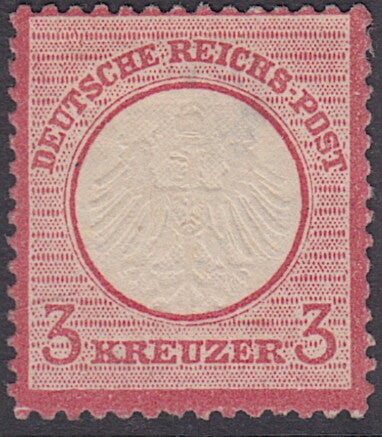
2. Small shield example.
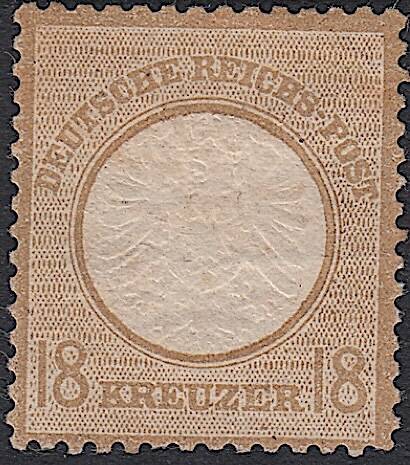
3. Large shield example.
4. High value example internal mailing.
5. Michel table of small breast shields from Michel (Mi.) 1 to 6 (GROSCHEN) and Mi. 7 to 11 (KREUZER).

6. Mi.12 and 13

7. Mi. 14 and 15.
8. Mi.16 to 28.
9. Mi.29 and 30.

10. Small shield 1872 GROSCHEN and KREUZER currency and typographed 10, 30 GROSCHEN examples. Michel labelling.
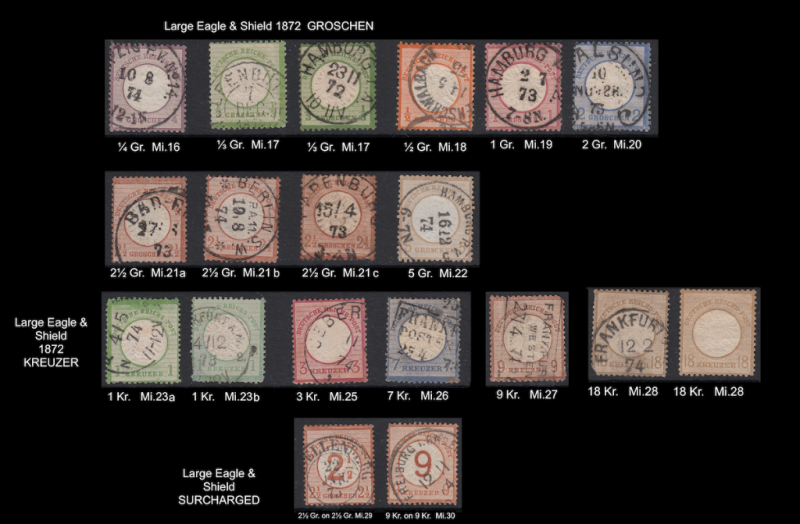
11. Large shield examples GROSCHEN and KREUZER. Michel labelling.
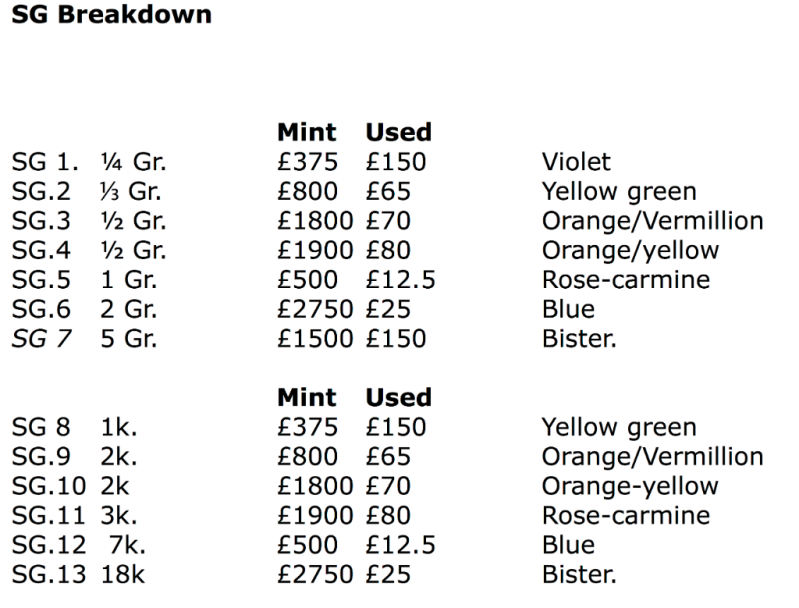
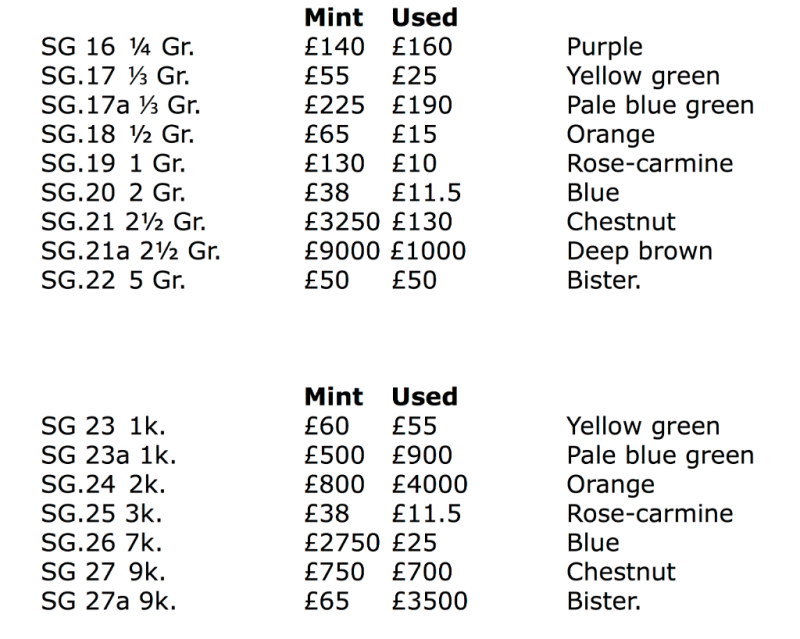

12. Stanley Gibbons CV list for early stamps. Missing is the SG.28 18K bistre mint £85 Used £3500. Overall significantly different to Michel.
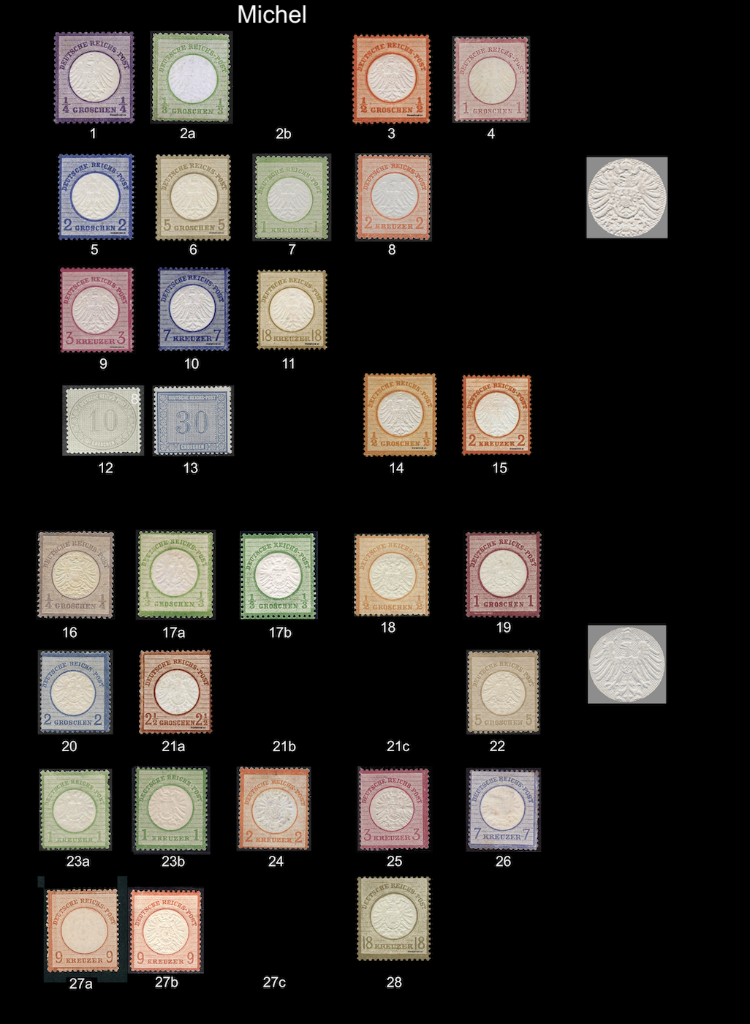
13. Some of my mint stamps.
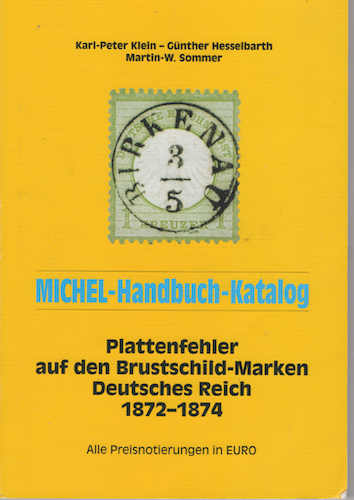
15. Essential Handbook for seeking out flaws.
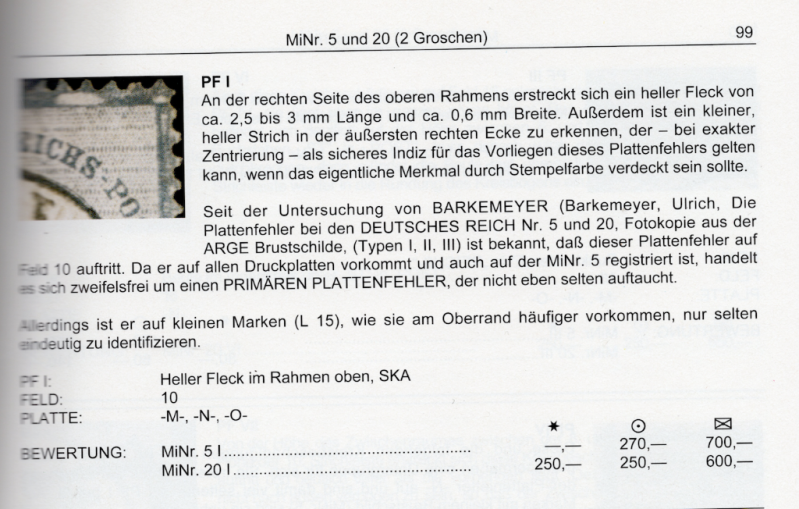
16. Example page from Handbook. The shows a flaw on Mi.5 and Mi.20. Note field and plate numbers given as well as estimate of CV in Euros.
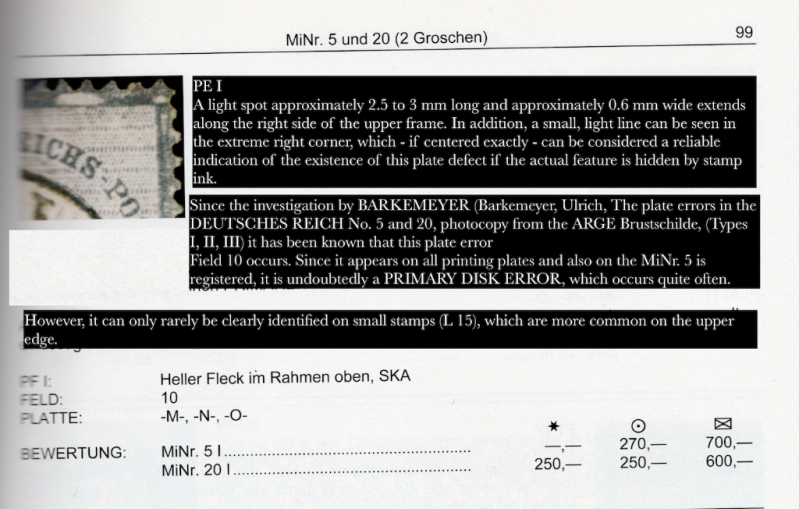
17. Page as in Figure 16. with translation.
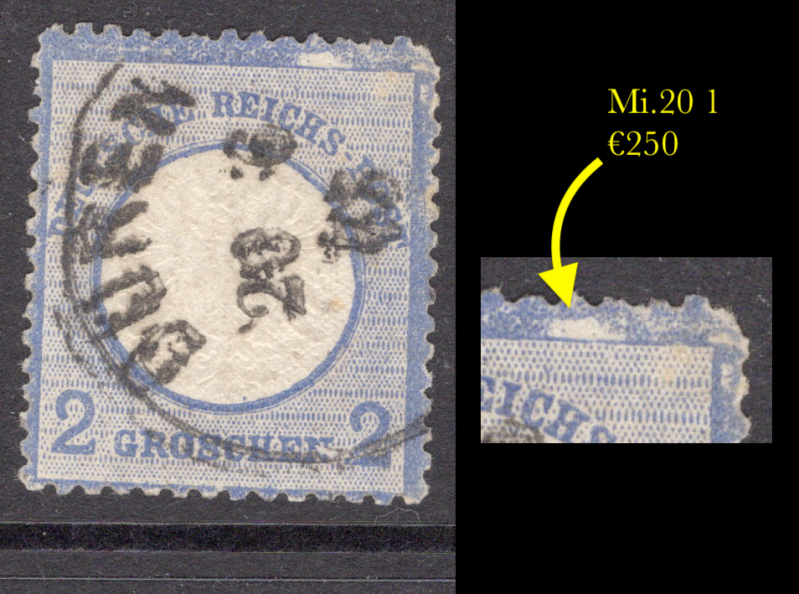
18. Mi. 20 with PF I flaw. Note CV of €250 as compared to basic non-flawed stamp of €7!
Some cartoons I made that may amuse.



Caption needed!
Section Two
Now, let’s look at flaws in more detail.
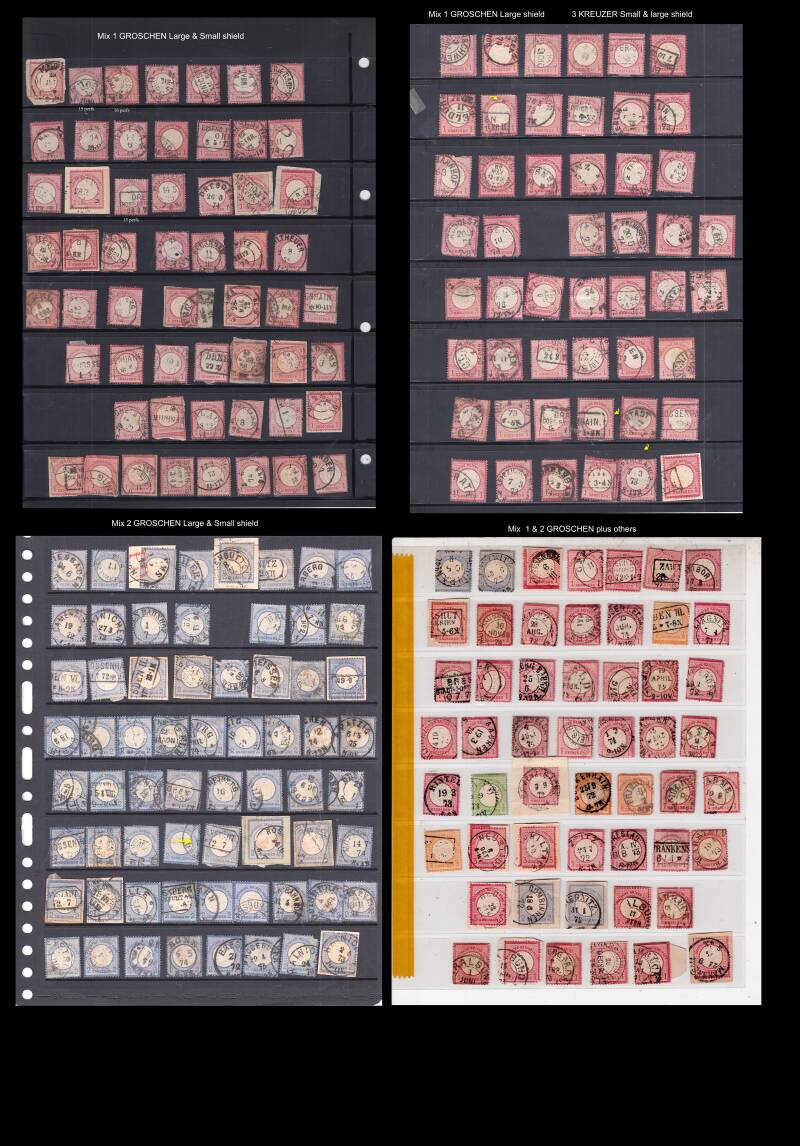
The figure shown below includes stamps acquired in bulk.
Most are low-CV, cancelled issues.
As mentioned above, these stamps have little intrinsic value, but they often contain overlooked flaws.
One concern is that others may have already examined them. However, in my experience, not everyone enjoys searching thoroughly for every possible flaw.
Below is an enlarged view of several stamps. This allows finer details to be observed, while the magnification, saturation, and sharpness can be adjusted to best highlight those details.
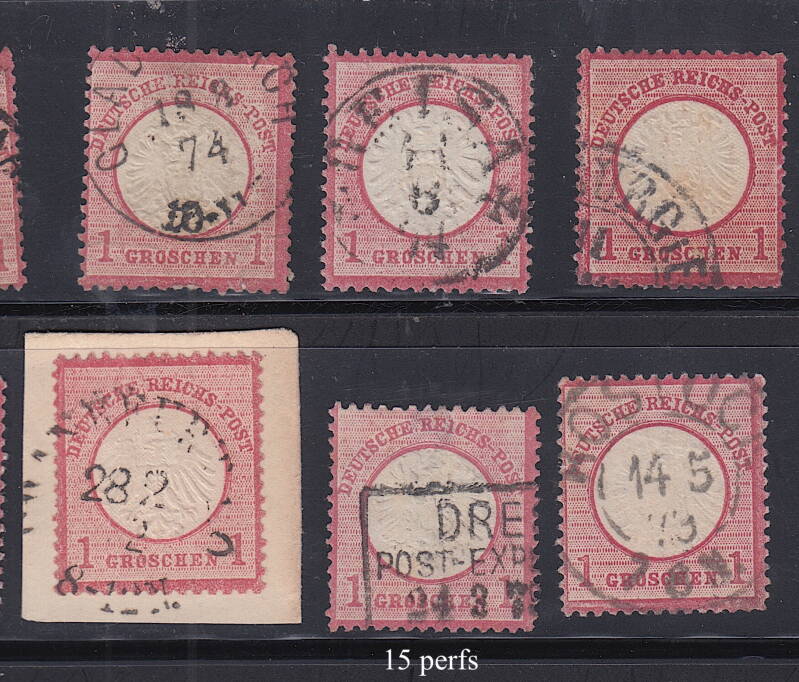
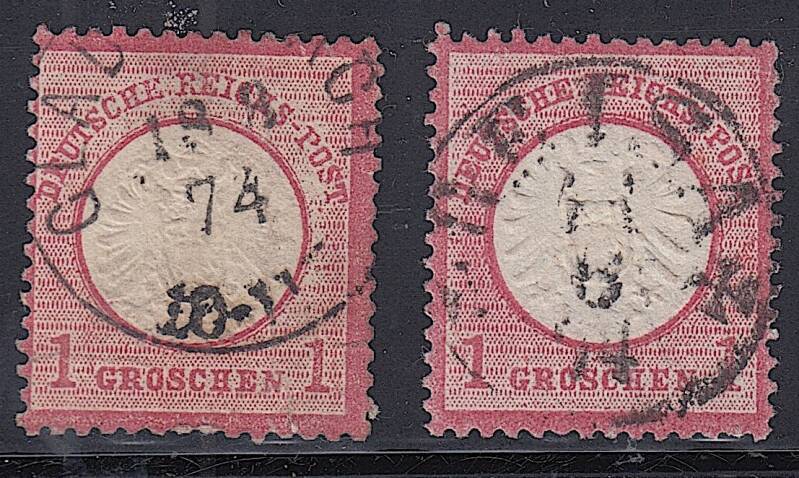
A selection of stamps shown at higher magnification.
This makes it easier to identify the Michel (Mi.) type—Large or Small Shield—and to examine any abnormalities closely.
The 15 perforations visible in the illustration serve as a reminder that the 1872–74 issues have perforation variations, as noted above.
What is a plate flaw?
A useful reference: Primary and secondary flaws on Breast Shield stamps
For these classic issues, primary and secondary flaws help distinguish significant, recurring printing or plate defects from minor, incidental variations.
1. Primary Flaws (Plate Flaws / Plattenfehler)
Primary flaws are permanent defects in the printing or embossing plates themselves.
Because they originate on the plate, they recur in exactly the same position on stamps throughout a sheet or print run.
These flaws are extensively documented, including in the Michel Plattenfehler Brustschilde handbook.
Examples include:
- Damaged inscriptions: Missing or broken letter fragments in the country name DEUTSCHES REICH or in the denomination inscriptions, such as a damaged circle below “DEU”.
- Frame breaks: Distinct cracks or entirely missing sections in the outer geometric border lines.
- Embossing plate flaws: The central Imperial Eagle was embossed separately from the coloured frame. Permanent damage to the relief die can result in malformed wings, missing claws, or a flattened crown.
- Constant ink marks: Persistent, identifiable dots or coloured lines that consistently alter part of the background design, such as a vertical colour line in the right-hand side bars.
2. Secondary Flaws (Random and In-Press Variations)
Secondary flaws are non-recurring variations that occur during the printing process.
They do not indicate a defect in the metal plate itself, but rather an imperfection in the way an individual stamp interacted with ink, paper, or machinery.
- Embossing shifts (inverted or off-centre): Because the Breast Shield eagle was applied in a separate mechanical press operation, the emblem may appear off-centre or substantially displaced. In the most extreme cases, the centre is completely inverted.
- Colour rings and ink smudges (Butzen): Dirt, dust, or dried ink particles can adhere temporarily to the roller, creating localised “doughnut holes” or blobs of colour that disappear after only a few sheets.
- Paper and gum creases: Folds in the paper before or during printing can leave blank, unprinted lines. Shrinkage in the thick gum may also produce secondary post-production flaws.
- Perforation inaccuracies: Misaligned perforating needles can produce highly uneven margins or missing corner holes.
Below are some examples from my stamps illustrating some of the points discussed above.
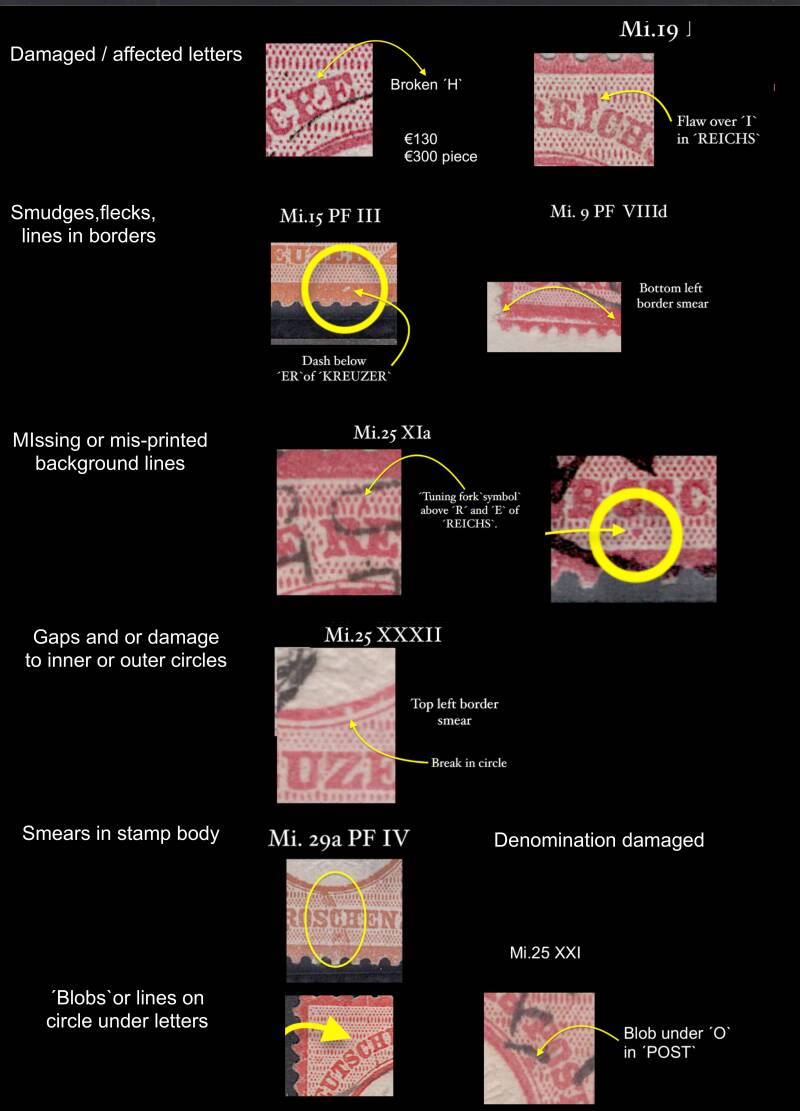
Now, let’s look at what I have found. Some of these examples may reveal similar flaws in your own collection; however, the Handbook is indispensable for anyone serious about identifying them.
To date, I have identified approximately fifty flaws.
Several occur on stamps with high catalogue values and were discovered in lots I purchased while trying to fill some of the more difficult gaps among the higher-value issues. Fortunately, the sellers overlooked these flaws—much to my advantage.
Many others appear on lower-CV stamps, while duplicates have proved invaluable in confirming and validating the flaws.
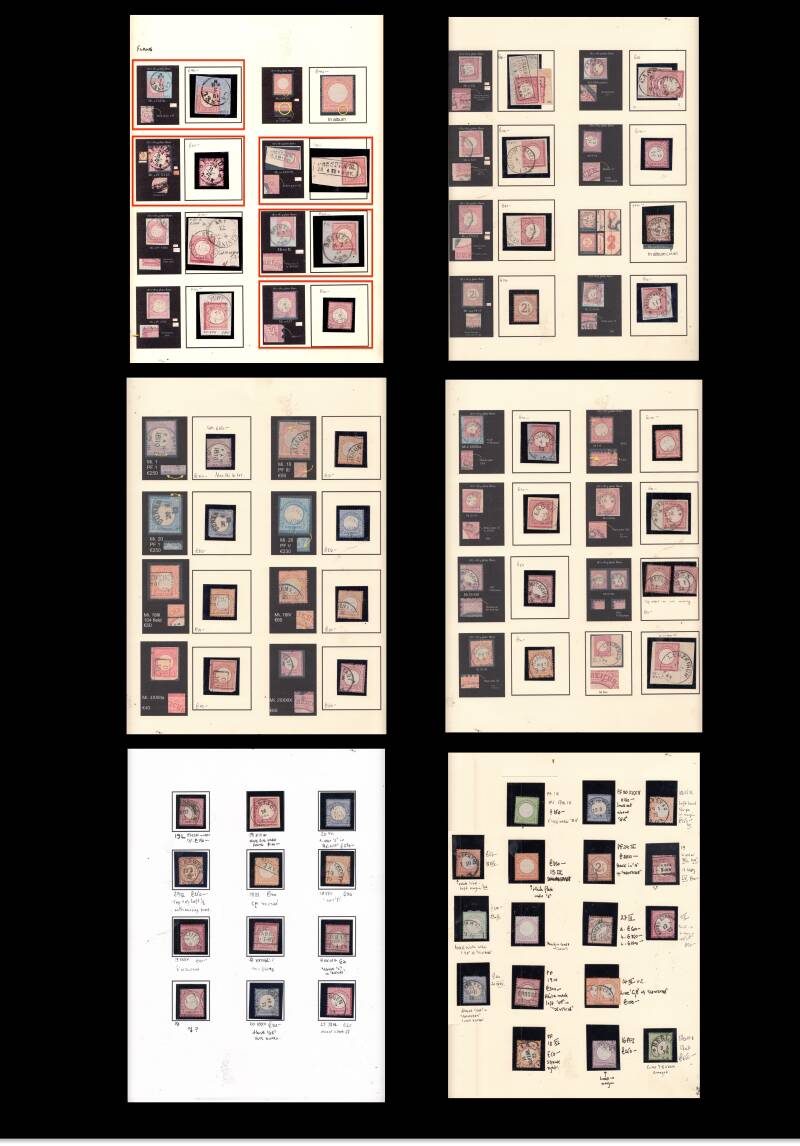
What follows is a preliminary overview of the flaws as they currently appear in my album.
It is intended simply to illustrate what I uncovered after acquiring the Michel Handbook.
The collection clearly needs to be reorganized, offering an enjoyable opportunity to re-examine the stamps and perhaps reconsider their often-hyped catalogue values.
I will use this space to organize the material and provide enlargements.
Remember the book? Essential to progress in search for flaws.
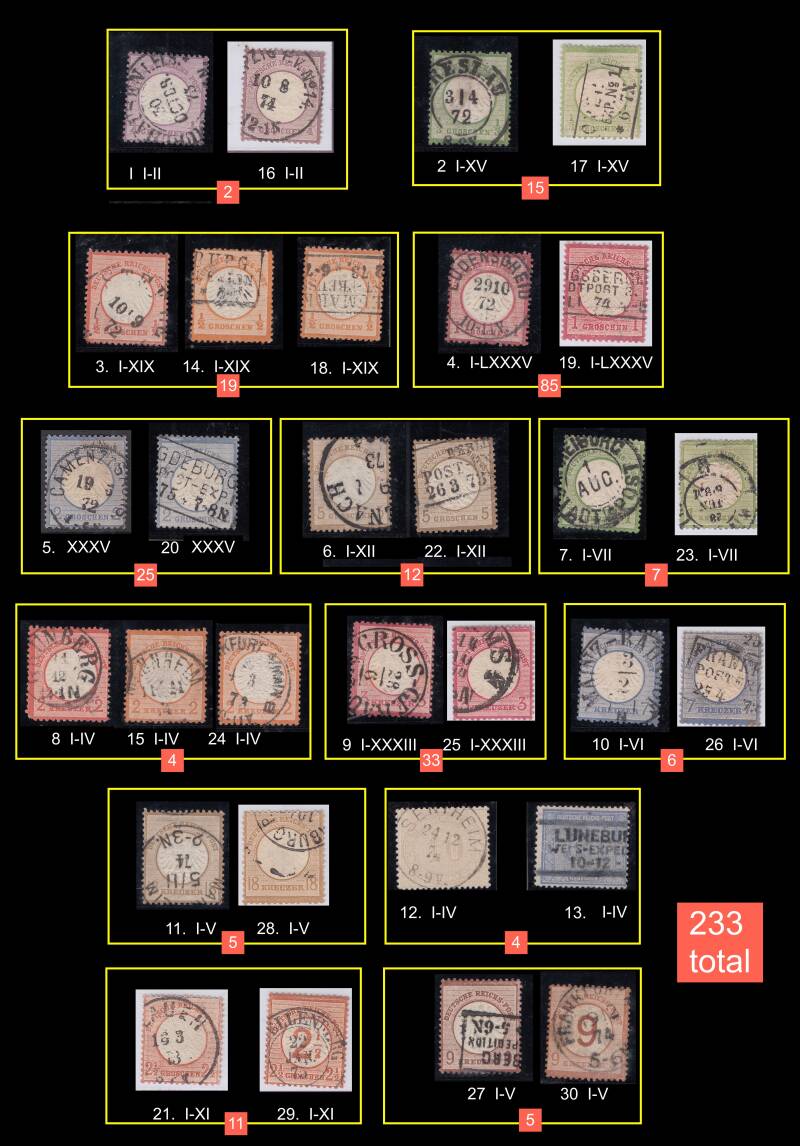
The Handbook lists 233 flaws.
The figure below shows the number of flaws identified for each particular Mi. stamp, and I have included examples of the affected stamps as a visual aid.
In general, the flaws are identified by denomination and by stamps with either small or large shields.
The Handbook uses Roman numerals to identify the flaws. In each case, I indicate the range from I to the final listed flaw.
For example, Mi.6 and Mi.22 are listed as I–XII (1 to 12), and so on.
I have also added the total number of flaws described shown in orange boxes.
Screw-head impressions
Before presenting examples of these flaws, I should mention another feature to look out for screw-head impressions, known in German as Schraubenkopfabdrücke or Schraubenabdruck.
The Handbook records these impressions in connection with certain flaws and denominations.
I must admit that I have not yet examined them closely, but I intend to do so from now on, one of the advantages of creating these web pages.
A screw-head impression occurs when the head of a fixing screw on the printing press,,used to secure the printing die or plate to its base, comes into contact with the paper during printing.
- Appearance: The impression may appear as a faint circular mark, often in the colour of the surrounding print or overprint. It can show the outline of the screw head, its slot, or the raised rim around it.
- Location: In this issue, screw-head impressions occur within the otherwise unprinted inner circle of the Brustschild. They are confined to the centre of that circle and do not appear in its peripheral areas.
Information from the Handbook
Screw-head impressions, abbreviated SKA from the German term, are a particular type of printing anomaly.
The screws used to secure the printing die occasionally left distinct inked marks in the otherwise unprinted inner circle of the Brustschild.
They are therefore classified as secondary plate flaws.
Except for the extremely rare complete impression of a slotted screw head, three principal forms can be distinguished:
- The “Moon” (Form M): an impression of the outer contour of the screw head, usually appearing as one or more crescents.
- The “Slot” (Form S): an impression reproducing the contours of the slot in the screw head.
- The “Track” (Form F): a combination of the two preceding forms, resembling the hoofprint of an ungulate.
This phenomenon was caused by the screws used to fasten the printing die to its base, which was probably made of wood. The recessed inner circles, intended to remain free of ink, provided convenient locations for these fastenings.
In addition to the four corner positions of the 150-stamp sheet—positions 1, 10, 141, and 150—screws were also used in the central positions along the horizontal and vertical outer rows: positions 71 and 80, and 6 and 146, respectively. The reason these screws began to print with the design was probably material fatigue and mechanical stress during mass production.
SKAs frequently occur together with primary plate flaws. Closer examination suggests that both may have the same cause: improper use of a screwdriver, which could raise the fastening screw head while also damaging the delicate surface of the printing plate nearby.
The Handbook concentrates chiefly on SKAs associated with a primary plate flaw. However, distinctive SKAs, including their characteristic sheet positions, are also known without an accompanying plate flaw or plate marking.
Research into SKAs remains ongoing and offers considerable scope for further study, especially in identifying their sheet positions.
Quarter GROSCHEN Breast shield plate flaws Mi.1 and 16

One third GROSCHEN Breast shield plate flaws
Mi.2a, Mi. 2b & Mi.17
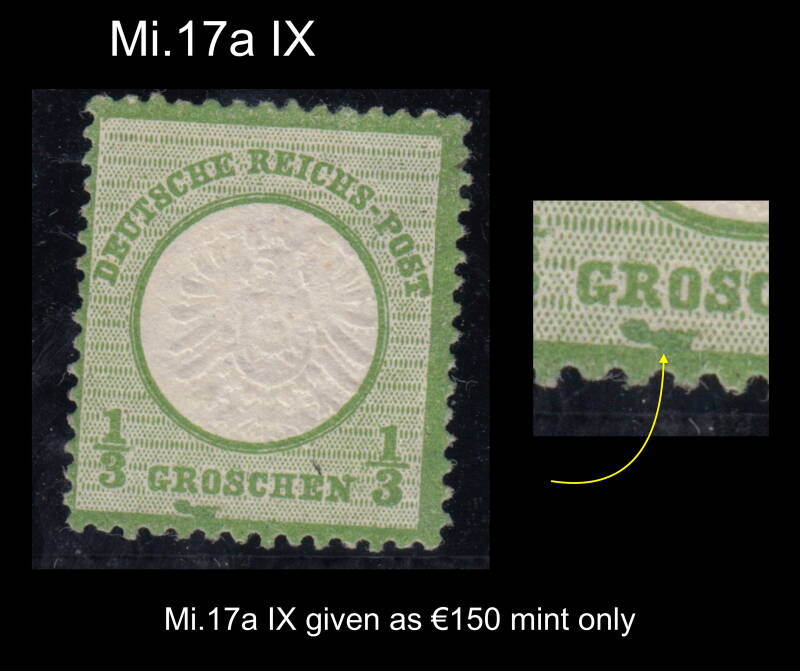
M.17a IX. An excellent well defined flaw, easy to see. only even as on a mint stamp.
This is useful in that it occurs on Mi.17a (not 17b) so helps in shade differentiation of the Mi.2 and 2b as well a Mi.17a and b.
Such shades vary considerably in scarcity and hence CV.
From MIchel.
Mi 2a. light to dark yellowish- green
Mi.2b. dark grey emerald-green
Mi.17a. yellowish-green to (dark) yellow-green
Mi.17b (dark) emerald-green to (dark) olive-green
These descriptions of shade are a constant problem in assessing stamps. More later on this for all Geman stamps.
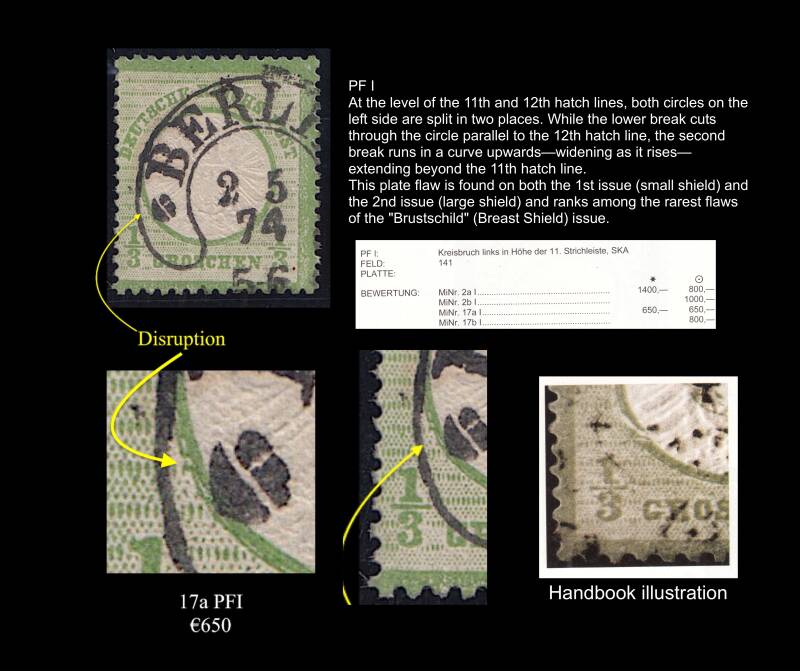
17a PFI. This one is difficult to assess. The disruption to the area above the left denomination is not exactly the same as the Handbook illustration. The stamps is the correct Mi. 17 for this flaw to occur. Below is another closer look.
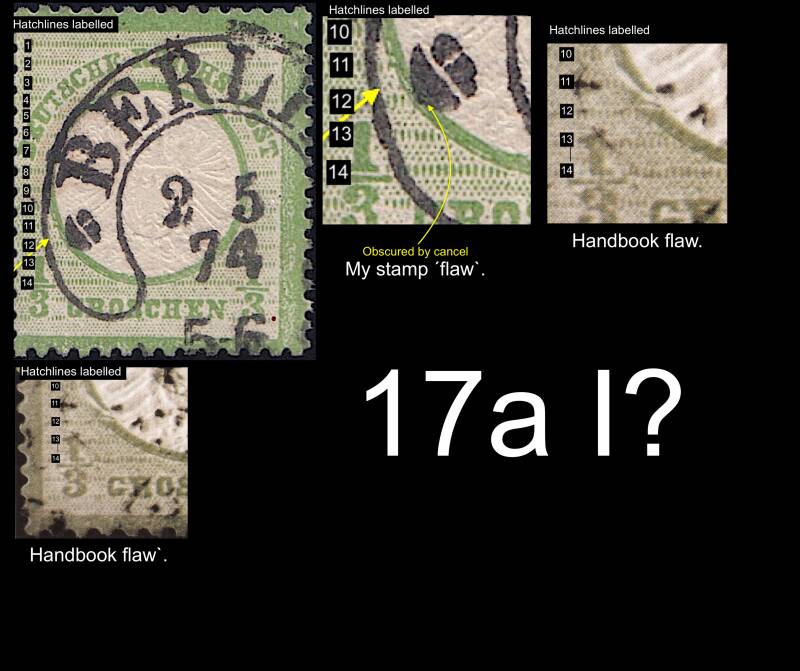
I have labelled the hatch lines from top. My ´flaw`is between the 11th and 12th hatchlines but is partially obscured at lower end by the cancel. I note that the stamp is over inked. Also that the outer light circle is irregular (over inking of green circle). Interesting, particulary since this is denoted as a rare flaw. I have not seen this type of damage to circles in any other flaw. I add the question mark of uncertainty.
Half GROSCHEN Breast shield plate flaws
Mi.3, Mi.14 & Mi.18
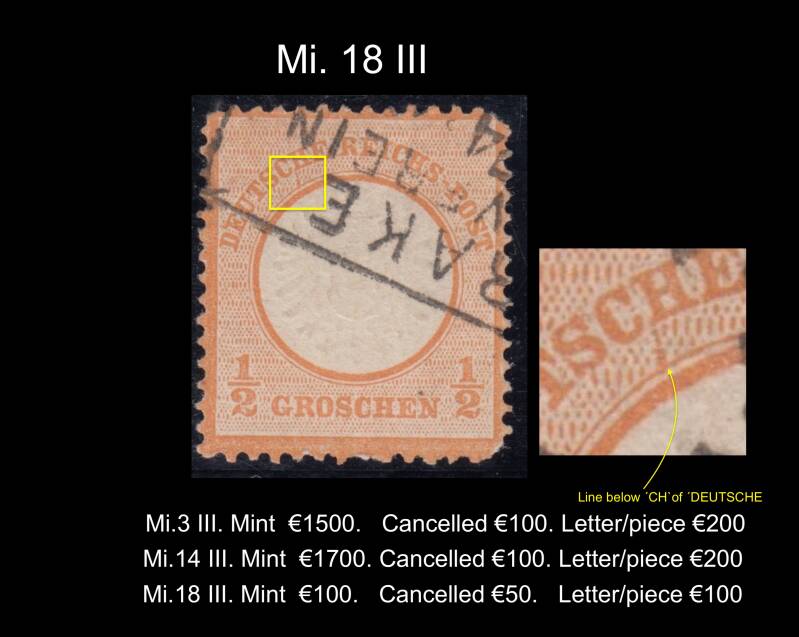
M.18 III. The CV of this flaw varies according to particular breast shield. Note very high CV for mint Mi.3 and Mi.14.
Here are Mi.3 and two Mi.14 (small shields) with flaw III.
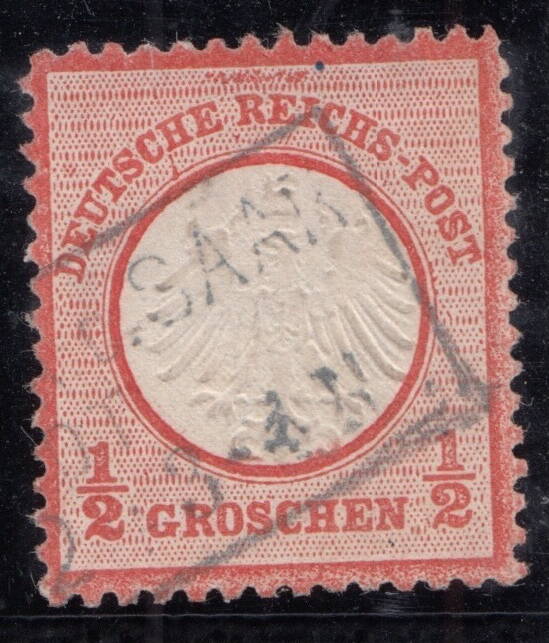
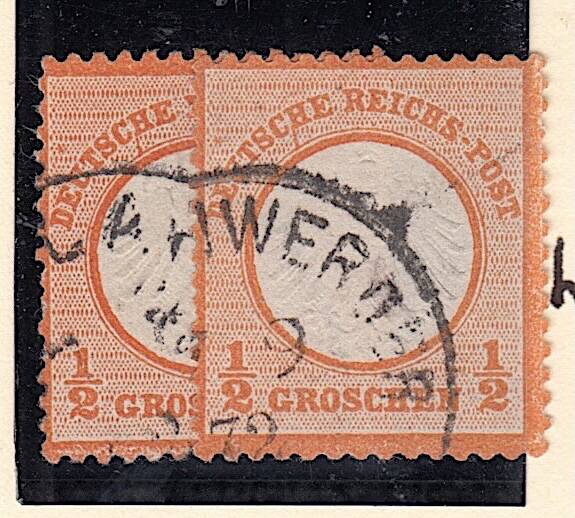
Mi. 3 III on left. Good edition of the shade of the Mi.3. Mi.14 II on right, Two stamps with small shields.
Mi.3 III CV cancelled €100 (€1500 mint) and Mi.14III CV cancelled €100 (€1700 mint).
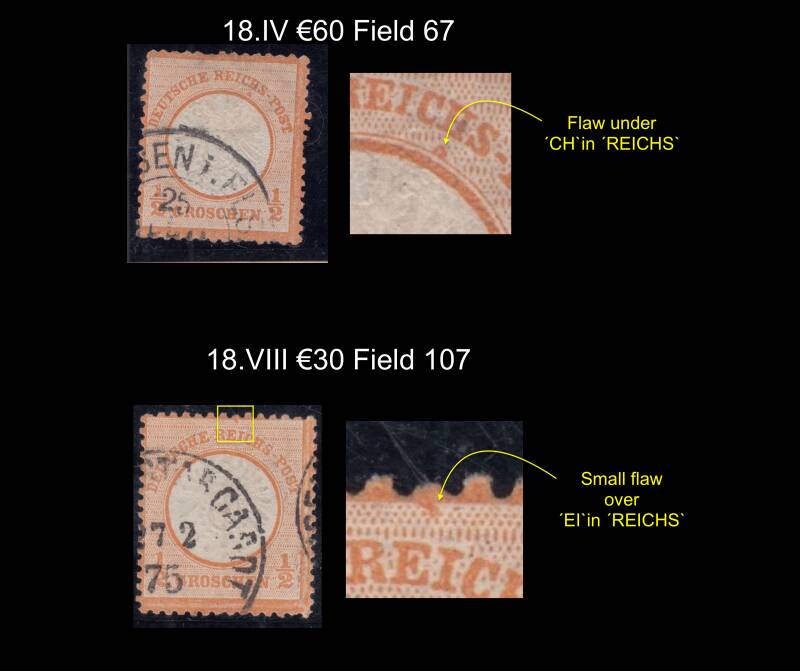
Mi.18 IV and Mi. 18 VIII. Two small flaws quite easily missed. Here the cancellations do not obscure the flaw areas.
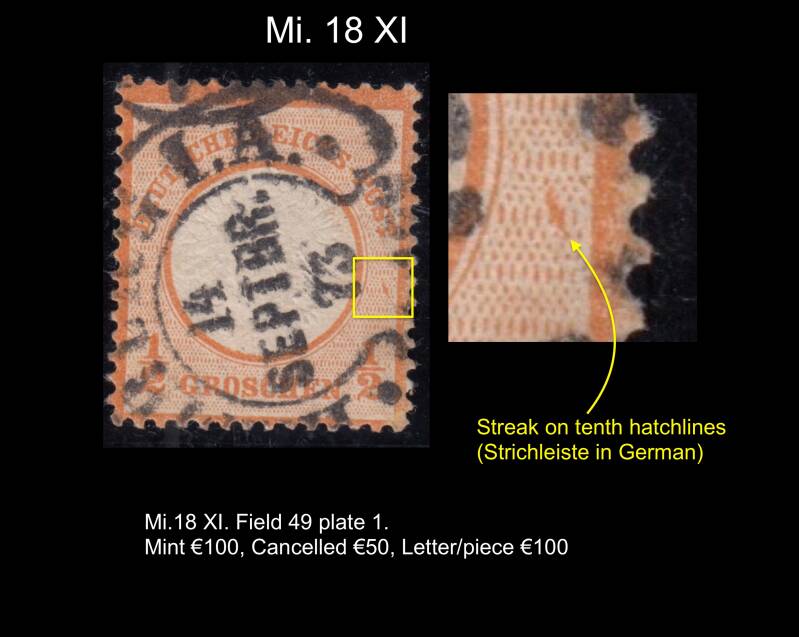
Mi.18 XI. Another that can be easily missed when cancels are heavy.
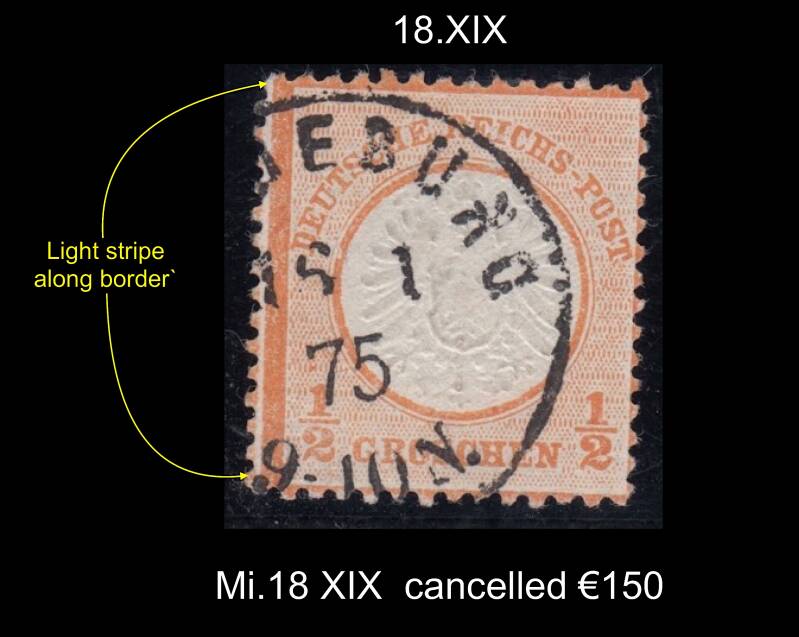
Mi.18 XIX. This one I nearly missed. There is a distinct white line running the whole length to the left of the left border.
One GROSCHEN Breast shield plate flaws
Mi. 4 & Mi.19
There are approximately 95 identified flaws on the Mi.4 through Mi.19 issues of the one-GROSCHEN stamps.
The Mi.19 issue has been studied extensively, in part because it was produced in large quantities and is therefore common.
As a result, it offers collectors an excellent opportunity to search for flaws without significant expense.
Mi.4 XXIIIa.
Breakdown of Mi.19 XXXIII a,b,c,d,e,f from Handbook
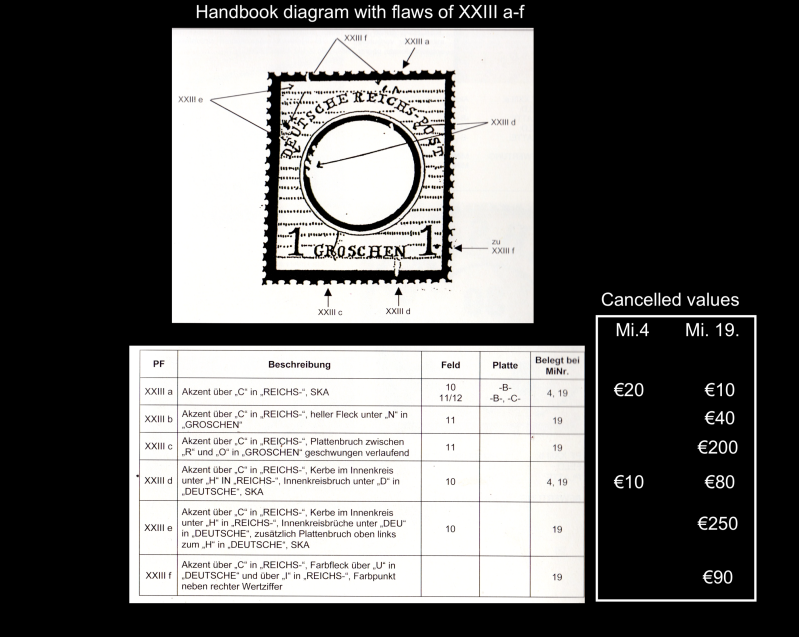
This points out other flaws associated with 19XXIII that subdivide the assessments.
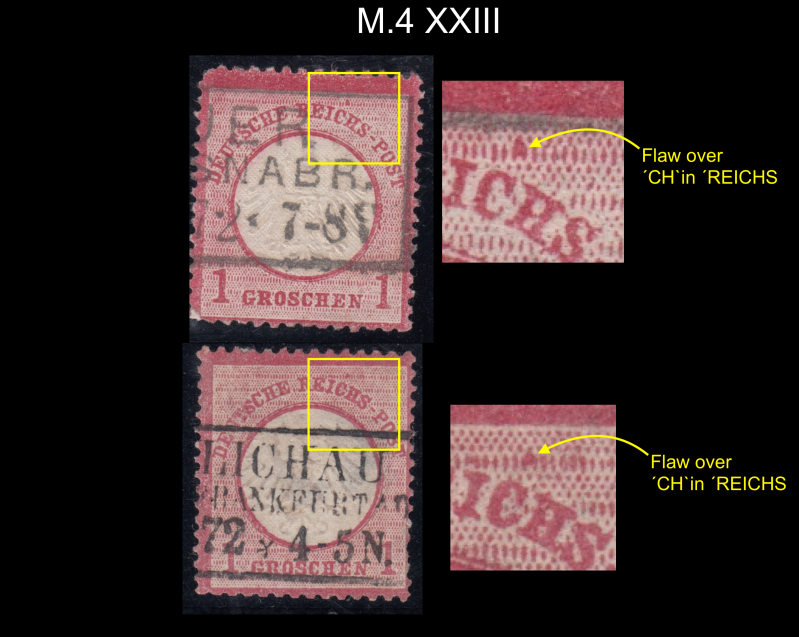
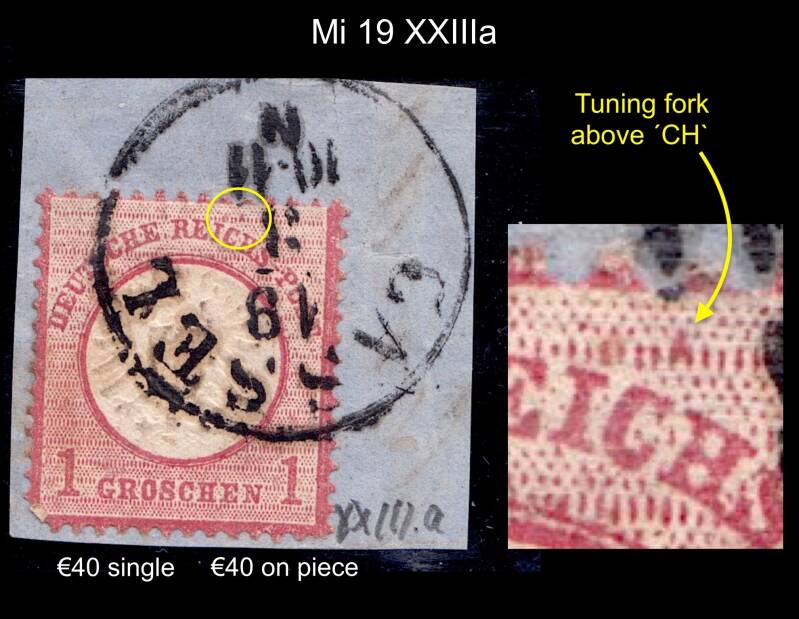
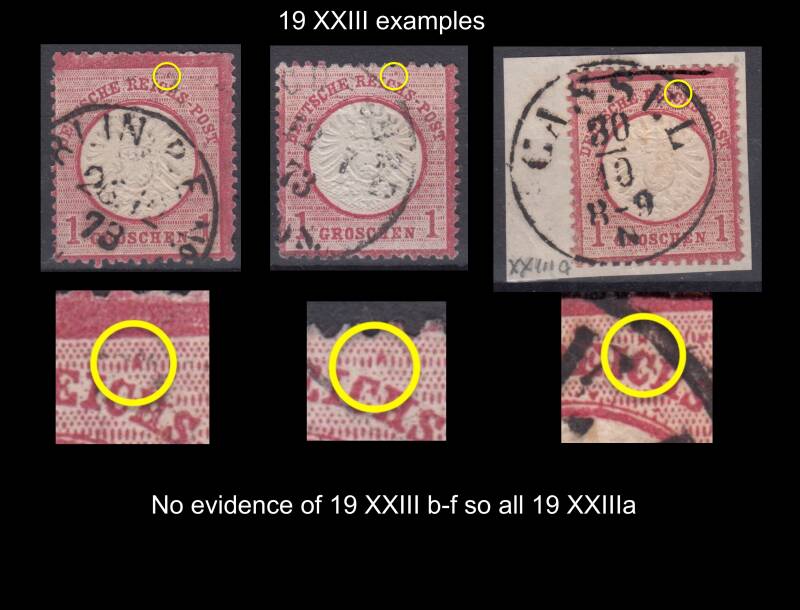
Stamps checked for other features as shown n Handbook table to see whether hey are XXIII b-f.
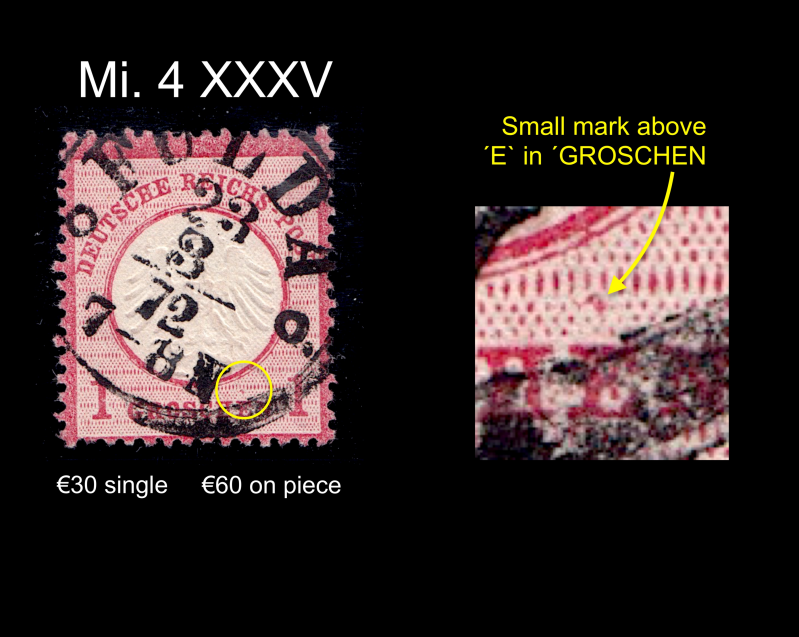
Mi.4 XXXV. Easily missed small flaw.
Now a run of Mi.19 flaws.
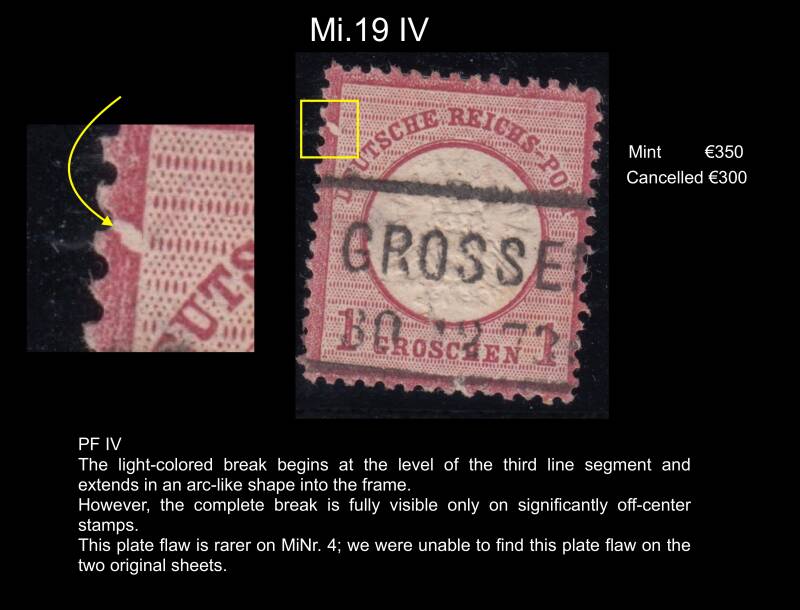
Note high CV for this flaw.
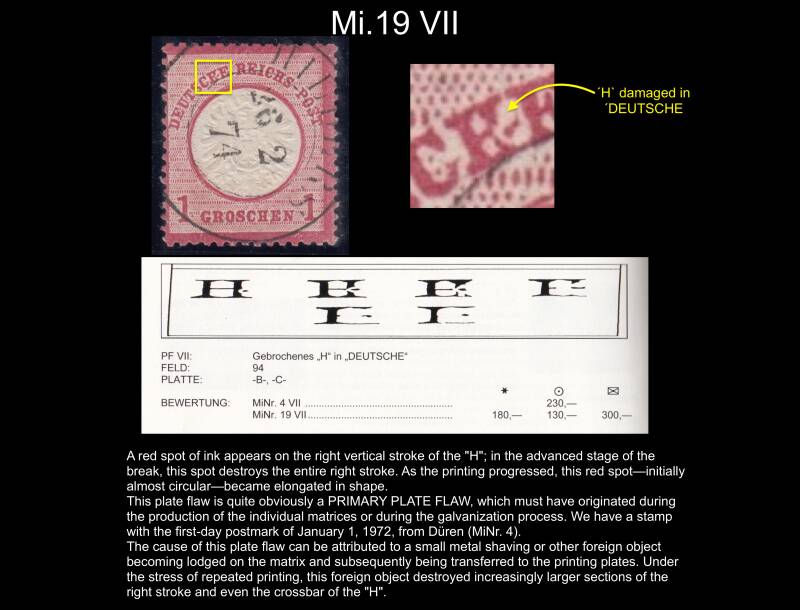
Handbook shows the development of this flaw.
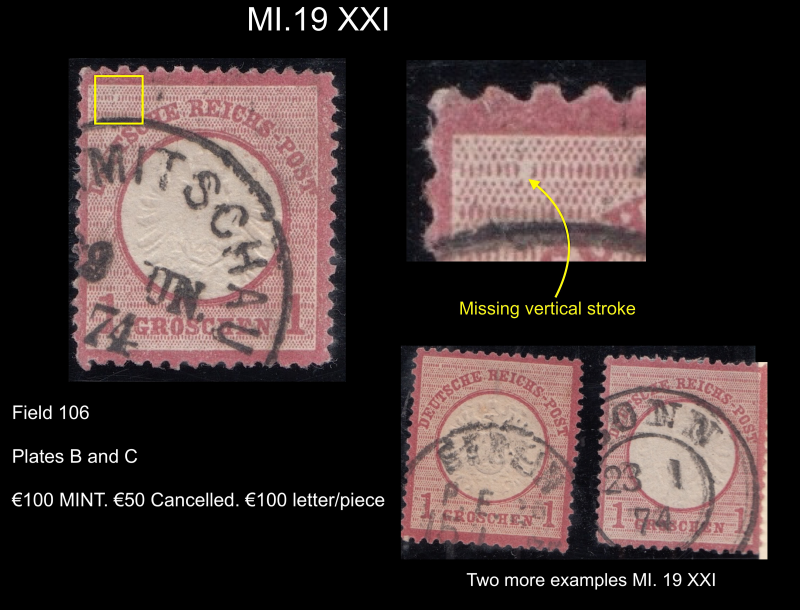
Care needed to look for this one.
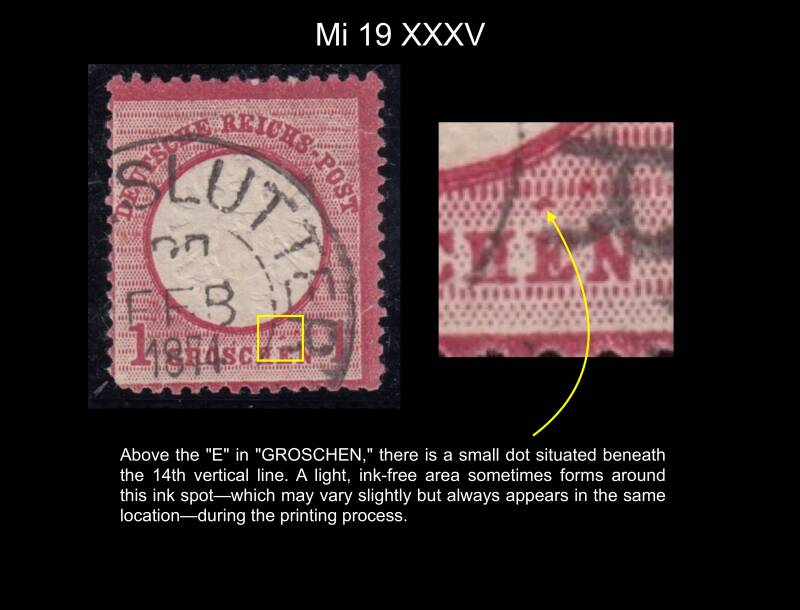
Another easy to miss flaw.
Nice nicked ´S`.
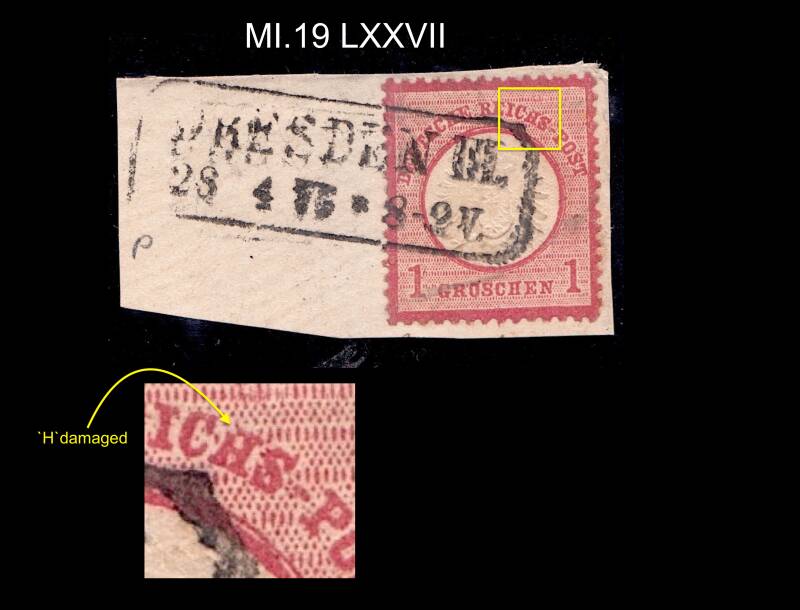
Not exactly as in Handbook but ´H` damage valid. CV €40.
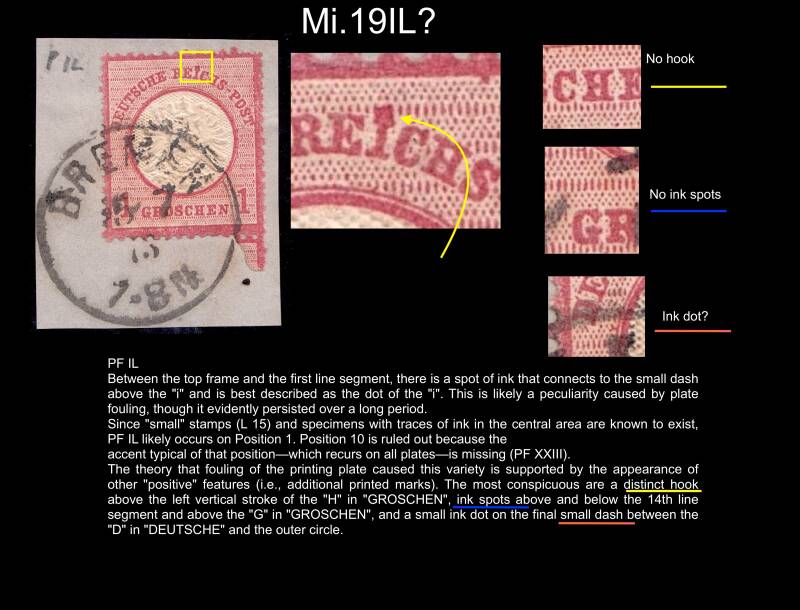
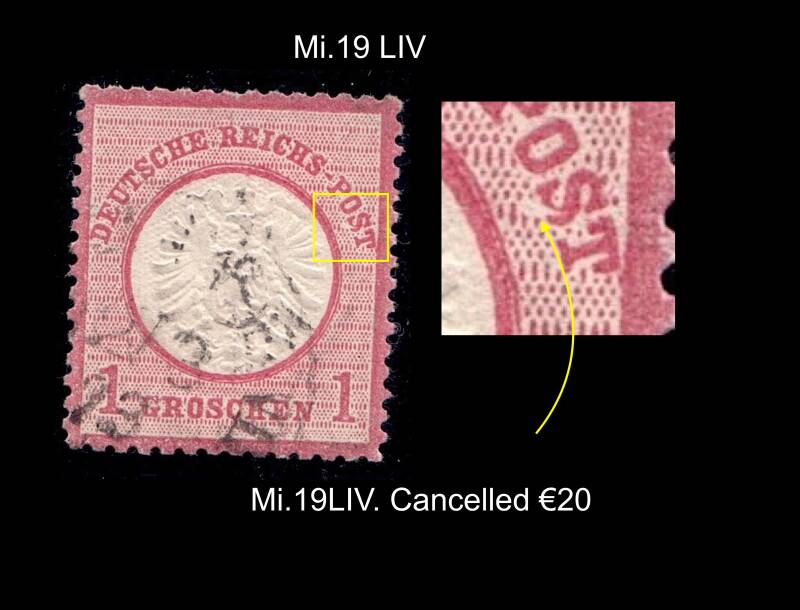
This does not appear to be a 19 IL as it is not between the ´I`of ´REICHS`and the border. Other features as listed are also absent.
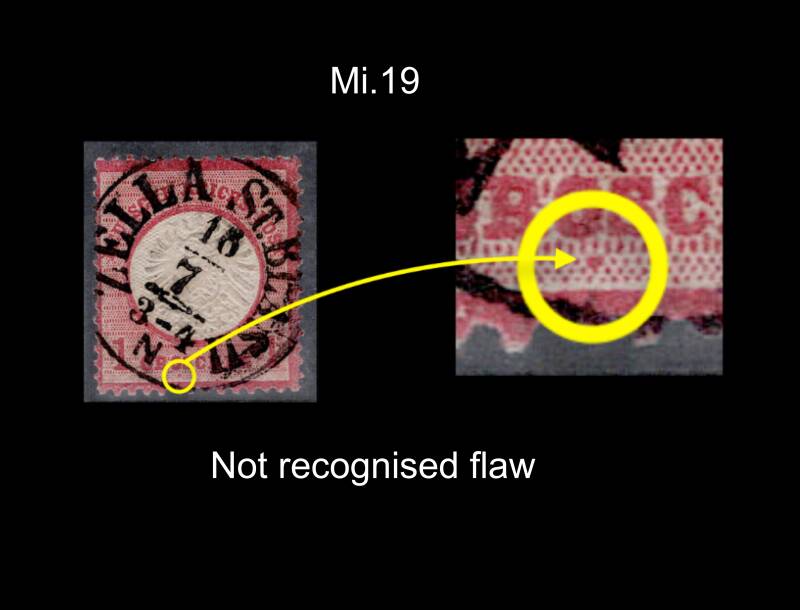
This is an easily to spot flaw but is not listed in Handbook.
Two GROSCHEN Breast shield plate flaws
Mi. 5 & Mi. 20
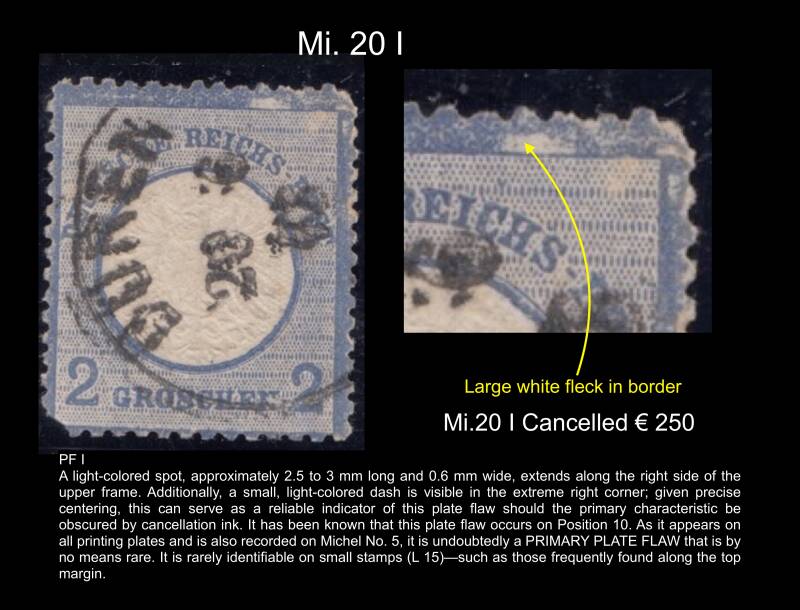
Take care when examining smudges around the borders. Some, such as this one, are recognised flaws.
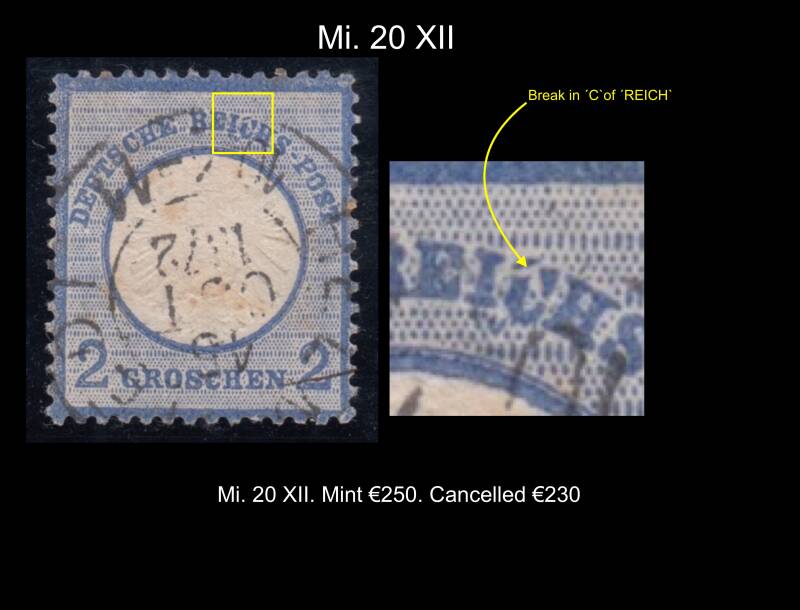
Another flaw that can easily be obscured by cancellation.
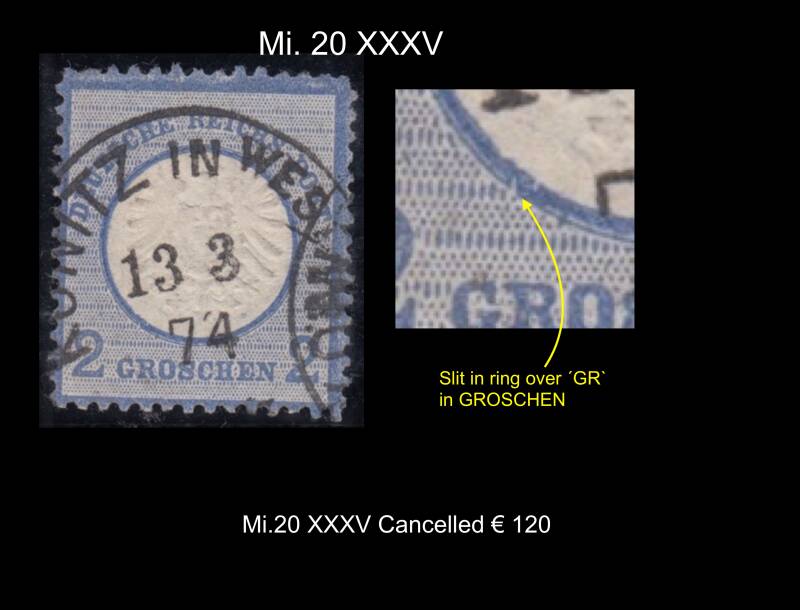
This is a tiny flaw and easily overlooked. There ae any flaws associated with the inner and outer lines of the circles from cuts, bulges and splits.
Two and a half GROSCHEN Breast shield flaws
Mi. 21 & Mi.29
I had some luck with the Mi.29 stamps, spotting Mi29b I, II, III, and IV with a combined catalogue value of around €1,300. All were found in eBay lots where the sellers had not identified them.
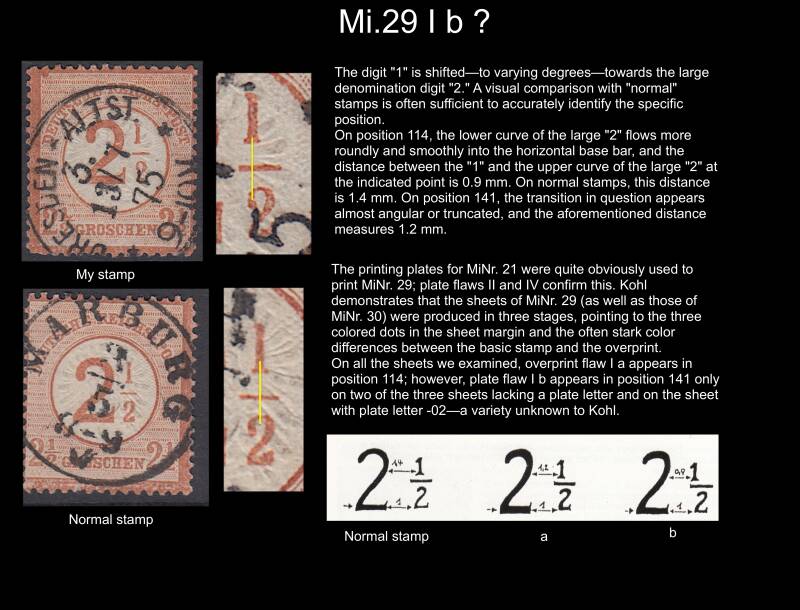
Mi.29 Ib canceled has a cv of €600. This shift is problematic and expert confirmation is required.
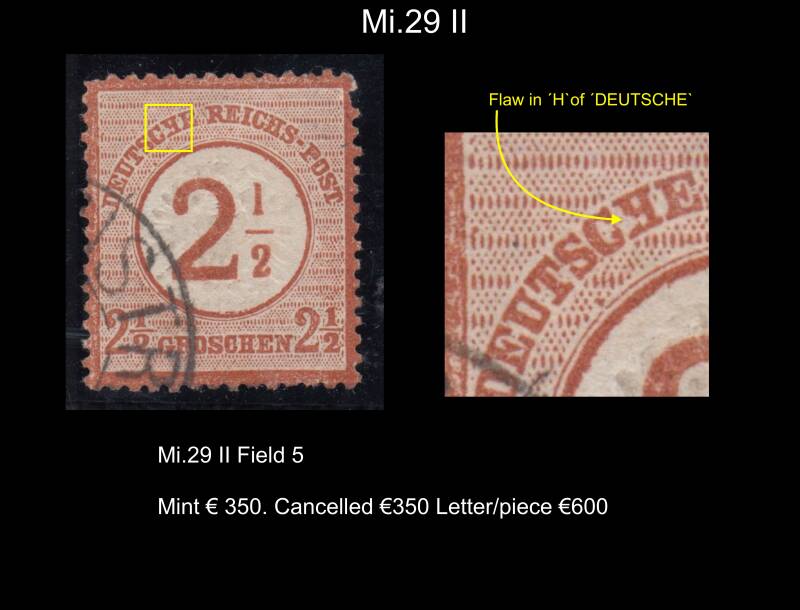
This seems genuine with a high CV.
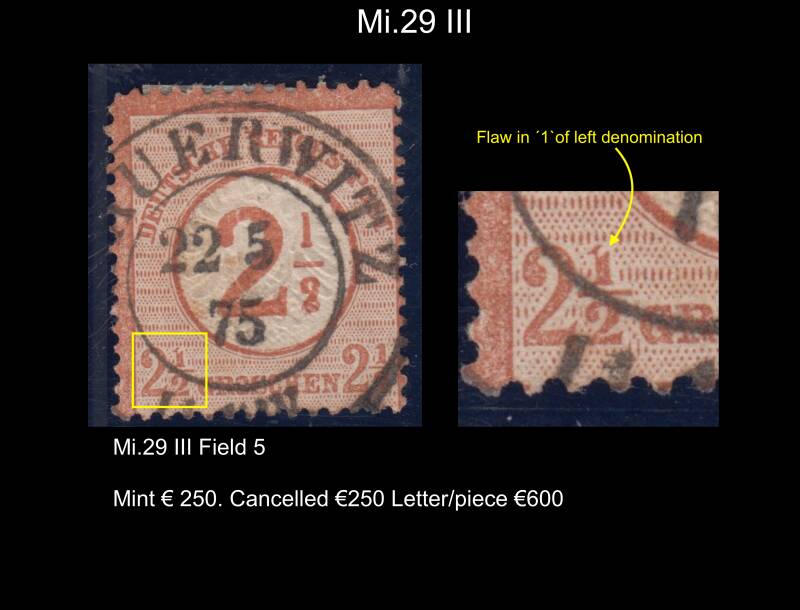
Genuine with a high CV.
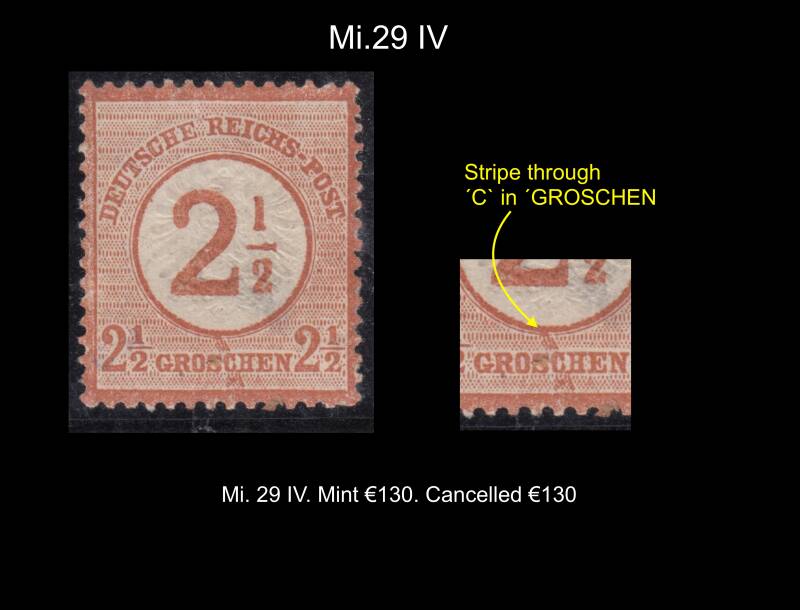
More unusual flaw.
Five GROSCHEN Breast shield flaws Mi. 6 & Mi.22
None as yet
Ten GROSCHEN Mi.1
None as yet
Thirty GROSCHEN Mi. 13
None as yet
One KREUZER breast shield flaws Mi. 7 & Mi.23
None as yet
Two KREUZER Breast shields Mi. 8, Mi.15 & Mi. 24.
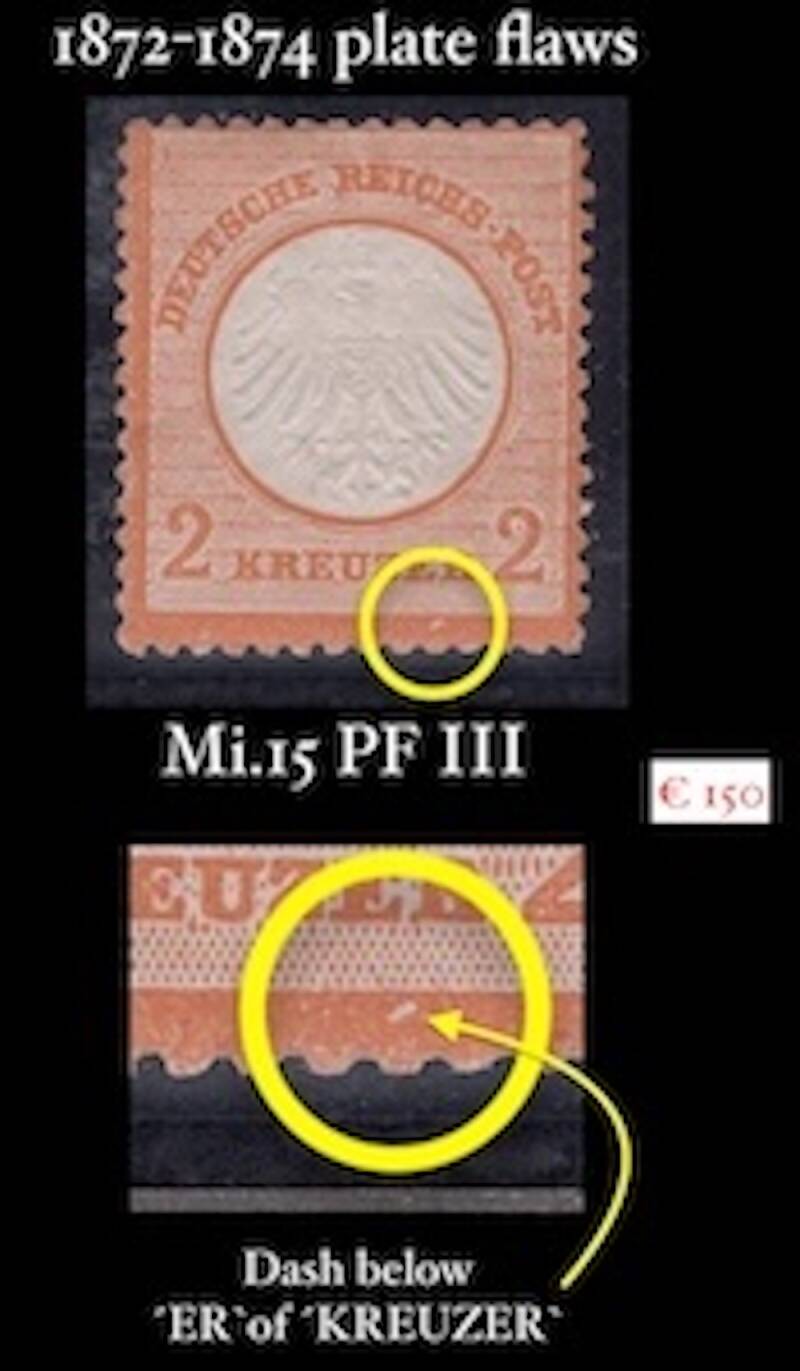
Mi.15 III. Easy to miss.
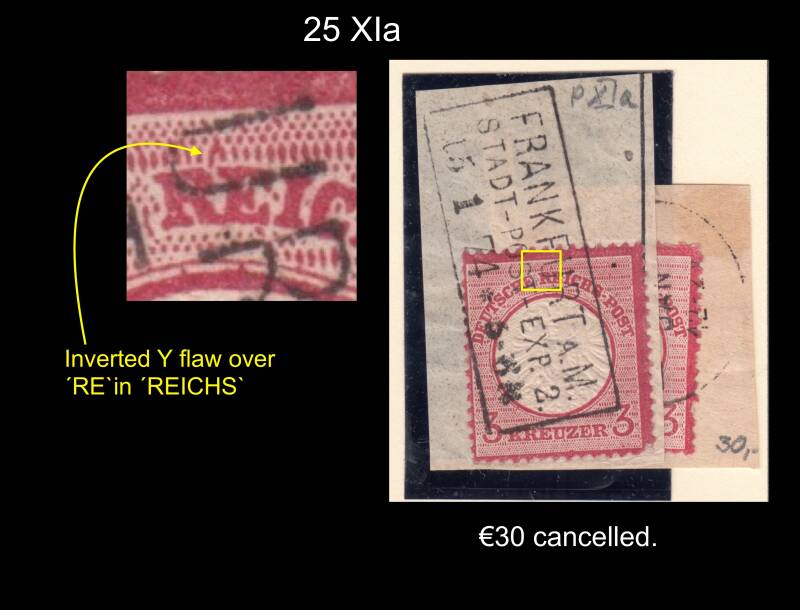
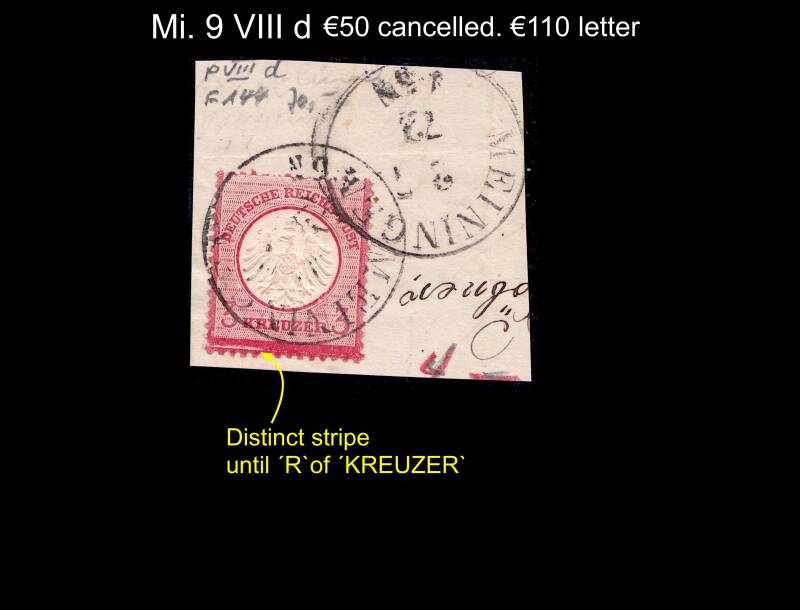
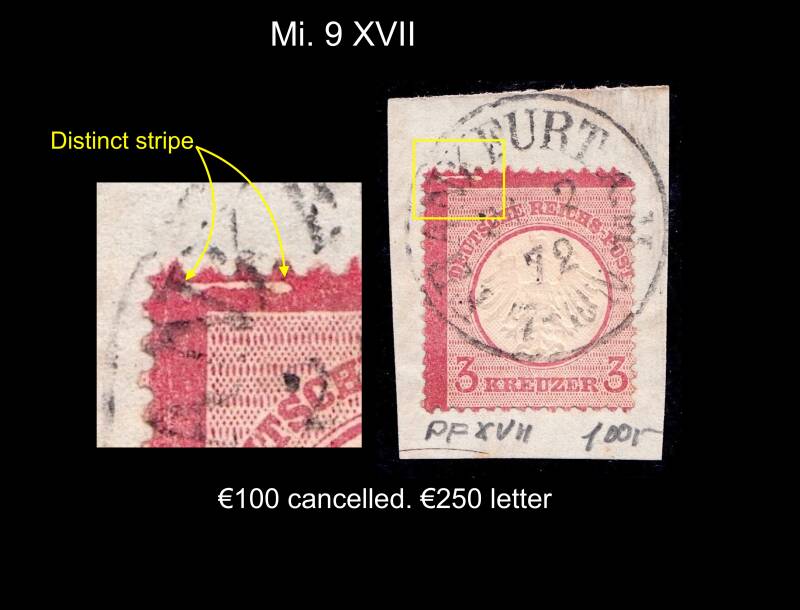
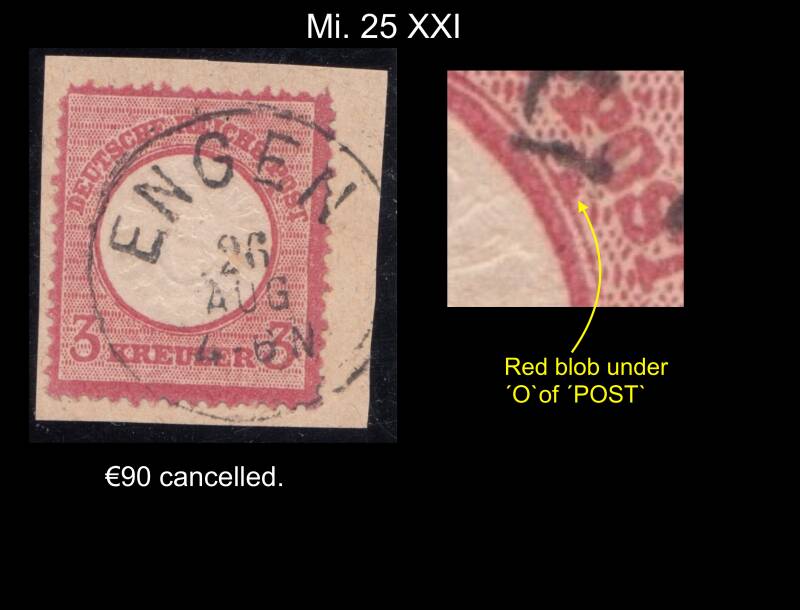
Three KREUZER Breast shields Mi.9 & Mi.25.
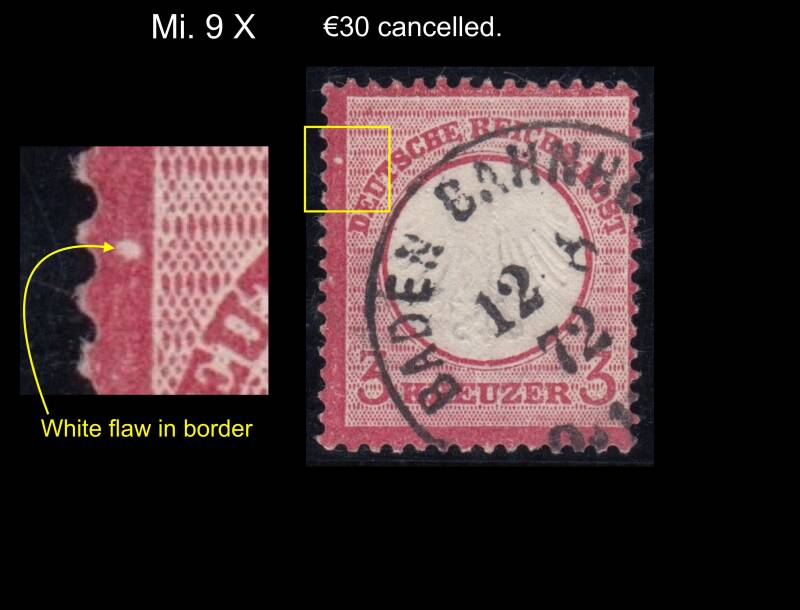
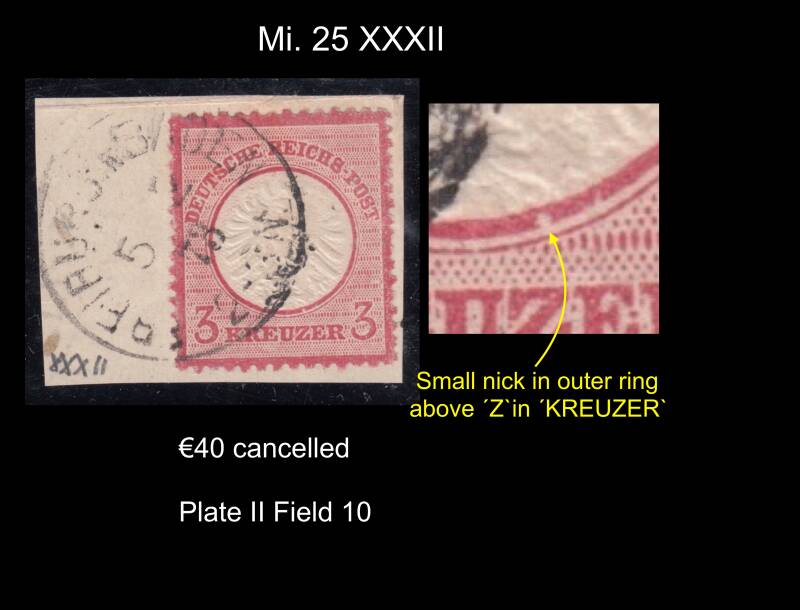
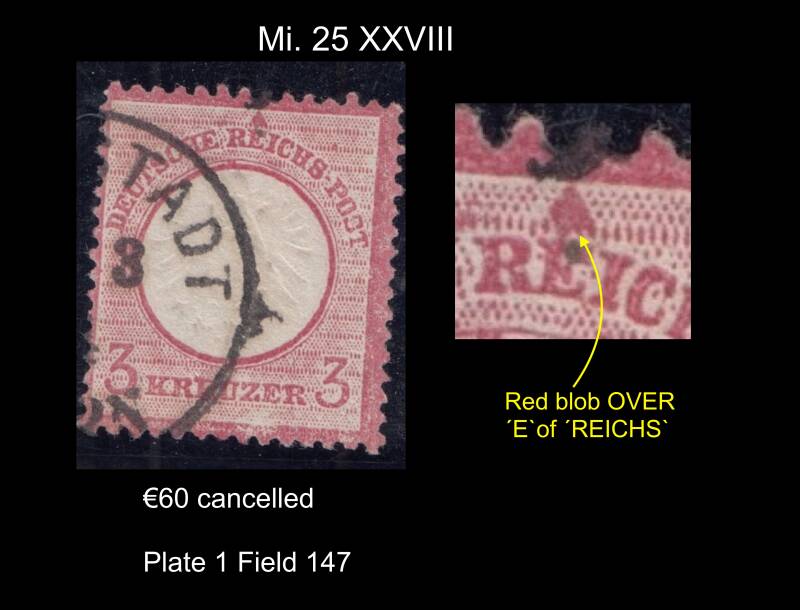
Seven KREUZER Breast shields Mi. 10 & Mi. 26.
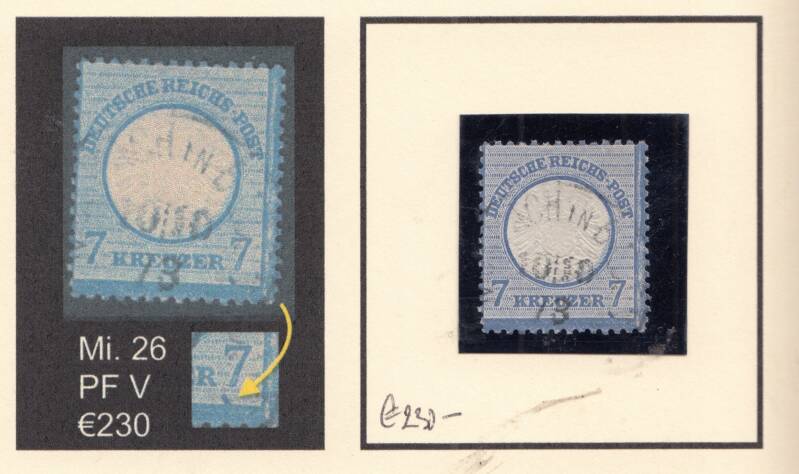
Mi. 26 V. Distinct spur under left ´7`. Cancelled €230
Nine KREUZER Mi 27 and 30 and eighteen KREUZER Mi.11 & Mi.28
No flaws to date
In conclusion, searching for flaws can be rewarding, whether as a casual review of stamps already collected or as a more focused effort involving the purchase of additional stamps.
The Handbook is essential for anyone wishing to make the most of this pursuit.
Flaws on higher-CV basic stamps are more difficult to find, as the cost of acquiring sufficient quantities reduces the statistical likelihood of discovering them. I have found several high-CV flaws on higher-value stamps sold as basic stamps, so perhaps many sellers do not have access to the Handbook or are simply not interested.

Uncovering hidden value in shades, flaws, and inflation postmarks
In standard albums, basic definitive issues often appear commonplace and have virtually no commercial value. However, specialized German philately reveals a dramatically different reality. A minute plate flaw, a rare color shade nuance, or an unrecorded perforation variety can suddenly push a stamp's Michel catalogue evaluation into hundreds or even thousands of euros. This is especially true during the hyperinflation period of 1923, where a verified, genuine contemporary date cancellation on cover or piece can turn an otherwise worthless, mass-printed stamp into an exceedingly rare, high-value showpiece.
Section Three
German Empire Stamps 1875 to 1900
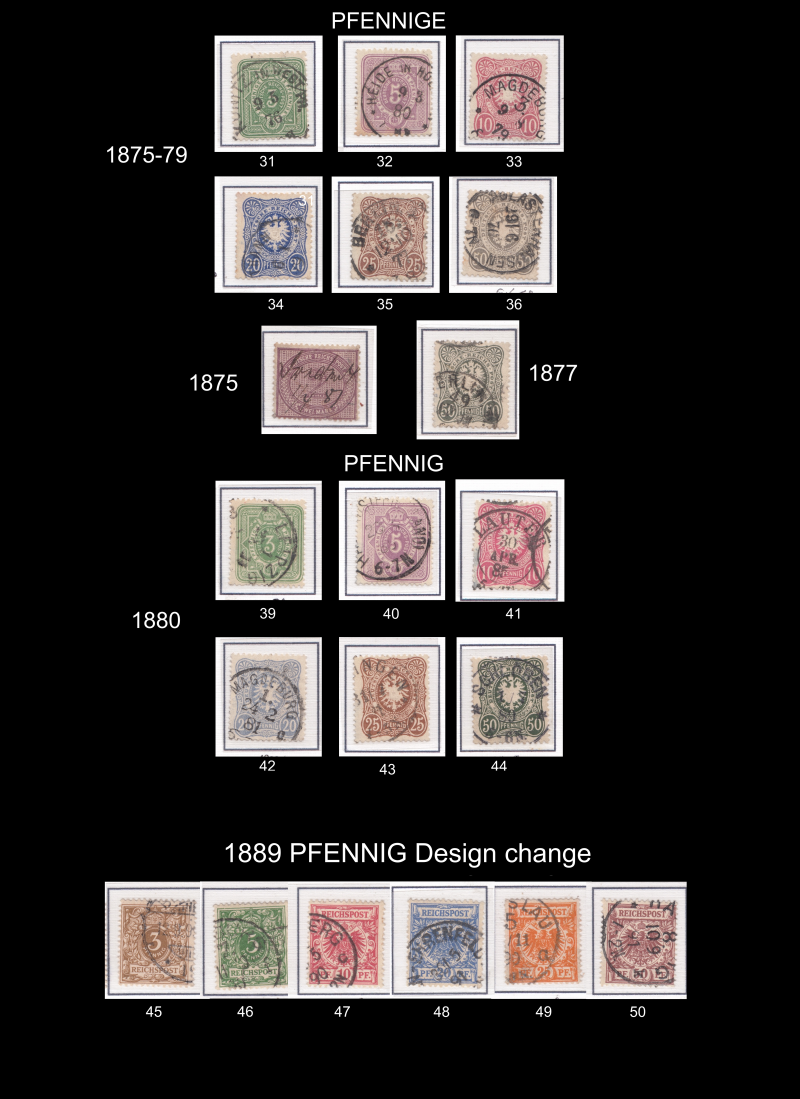
PFENNIGE and PFENNIG stamps.
Below are the stamps representing the basic issues from 1875 to 1900.
They are labelled according to the Michel catalogue.
Please note that the 1875 PFENNIGE issues share the same design as the 1880 stamps; however, the later stamps use PFENNIG without the E.
The wording was changed after German officials determined that the plural -E suffix was grammatically incorrect for currency denominations.
This era of stamps offers a rewarding collecting experience, with many specialised areas to explore—several of which can command higher catalogue values due to their greater scarcity.
See
Detailed look at my German Empire stamps 1875 to 1900
https://www.stampboards.com/viewtopic.php?t=67110&hilit=1875
Below is a brief list of areas of possible interest.
A Quick Look of the design of the issues Mi.33-36 & Mi.38 and the later Mi. 41-44.
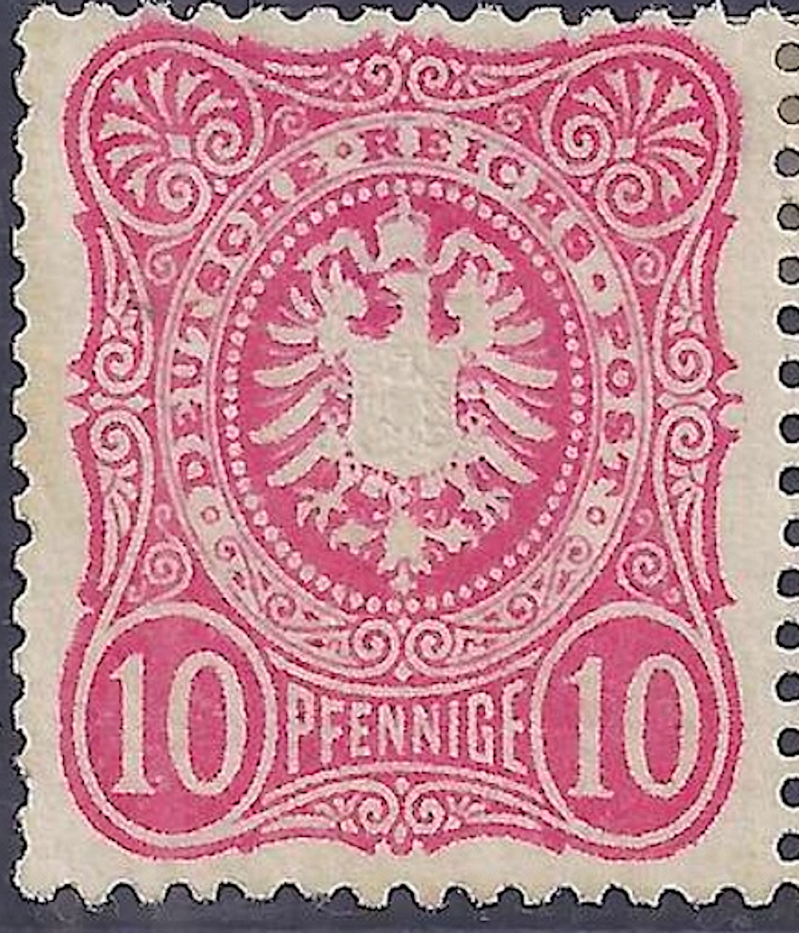
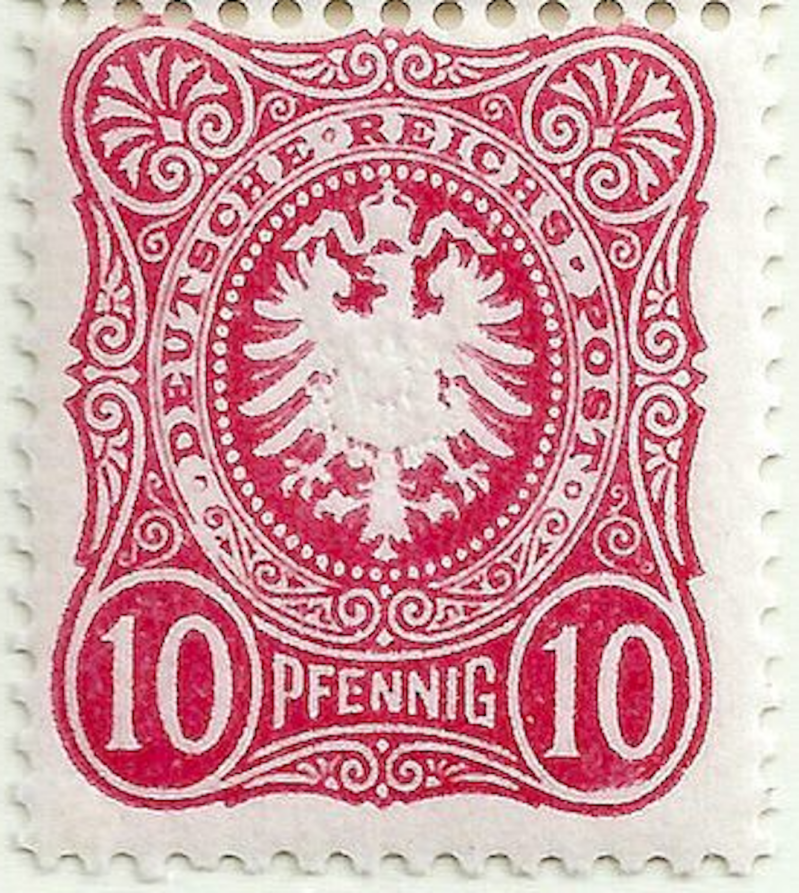
Very similar apart from the difference in the PFENNIG lettering.
Plenty of possibilities for flaw ´problems`due to the intricate design.
The PFENNIGE and PFENNIG issue was a design particularly ill -suited for typography. The outer edges of the design are short, inward-turned arcs, four sharp and very narrow indentations, more like notches with many sharp points. One finds stamps with thick, squashed frame lines and color burrs which have the effect of a double contour (The German term, as seen in the Michel "Pfennige" handbook, is "Randquetschdruck").
One can also find stamps in the vicinity of the gutters which show color lines along the edges. In those instances the filler material was too high and caused the color impression . The edges of the stamps were also prone to being damaged in the printing process due to hit or bump as the noticeable plate flaws.
Below is the MIchel table from the english version.
Michel table of 1875 -1879 Pfennige issues.
Sorry about the scrawls but I do not have an unused version. Well thumbed is an understatement!
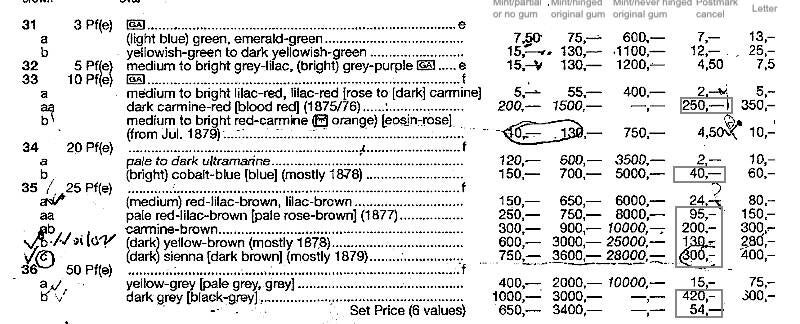
Unlike the later high-inflation period, the catalogue values (CVs) for most stamps in NHM and HM condition from 1875–1900 are very high. Consequently, there is less incentive to falsify cancellations on these issues than on the high-premium cancelled stamps of the high-inflation era that I will discuss later,
As the catalogue shows, shades are very important: they indicate scarcity and this is reflected in the CV.
Cancelled stamp values with relatively high CVs are highlighted in red boxes.
For example, 33a has a CV of €2, while 33aa is valued at €250.
Shade comparisons are best made—and may only be possible—when you have a reasonably large group of stamps of the same denomination.
It is also important to use expertised stamps as references for the true shade. However, some older expertisations may not be entirely accurate, and stamps may have changed shade in storage since their original examination.
A further challenge in identifying and showing shades after scanning is the variation between computer displays, as well as the general limitations of scanning.
In some cases, the date is essential for identification, so clearly dated examples are preferable.
Shades are associated with specific printing practices, such as variations in ink mixtures and changes in paper.
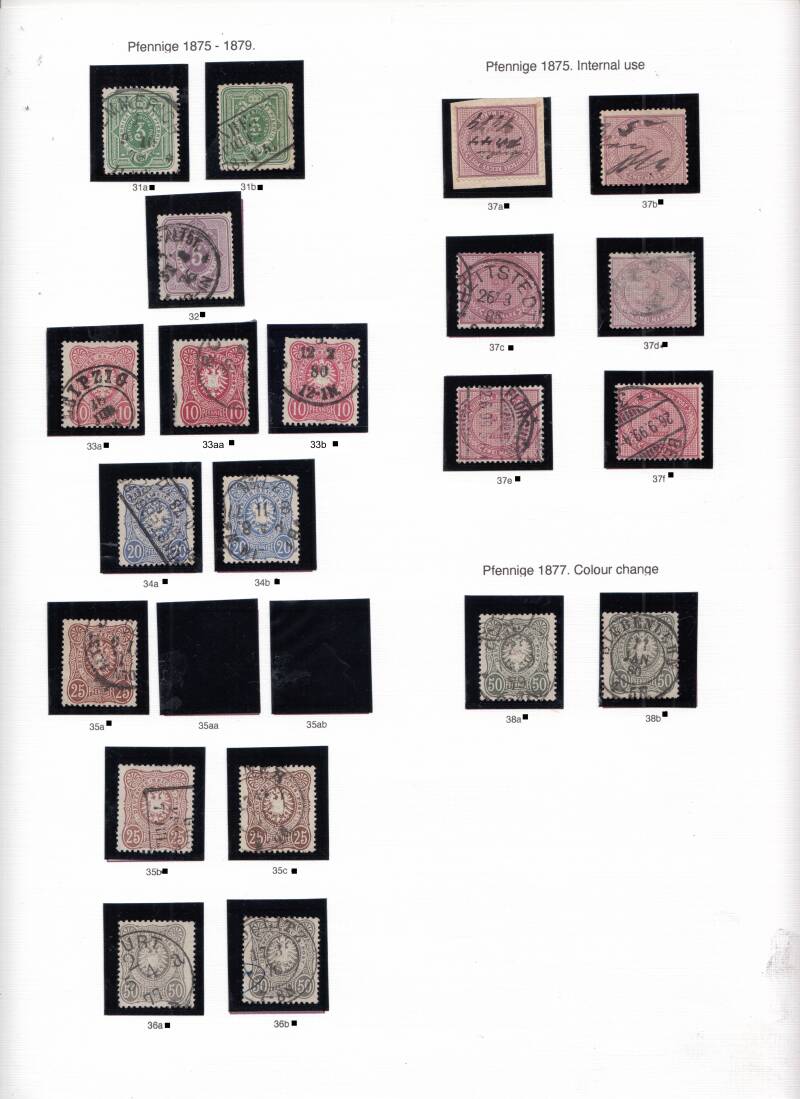
Here is a page of PFENNIGE Mi.31 to Mi.38 that I have collected.
The black squares indicate that the stamps have been proofed and as such can be regarded as genuine shades.
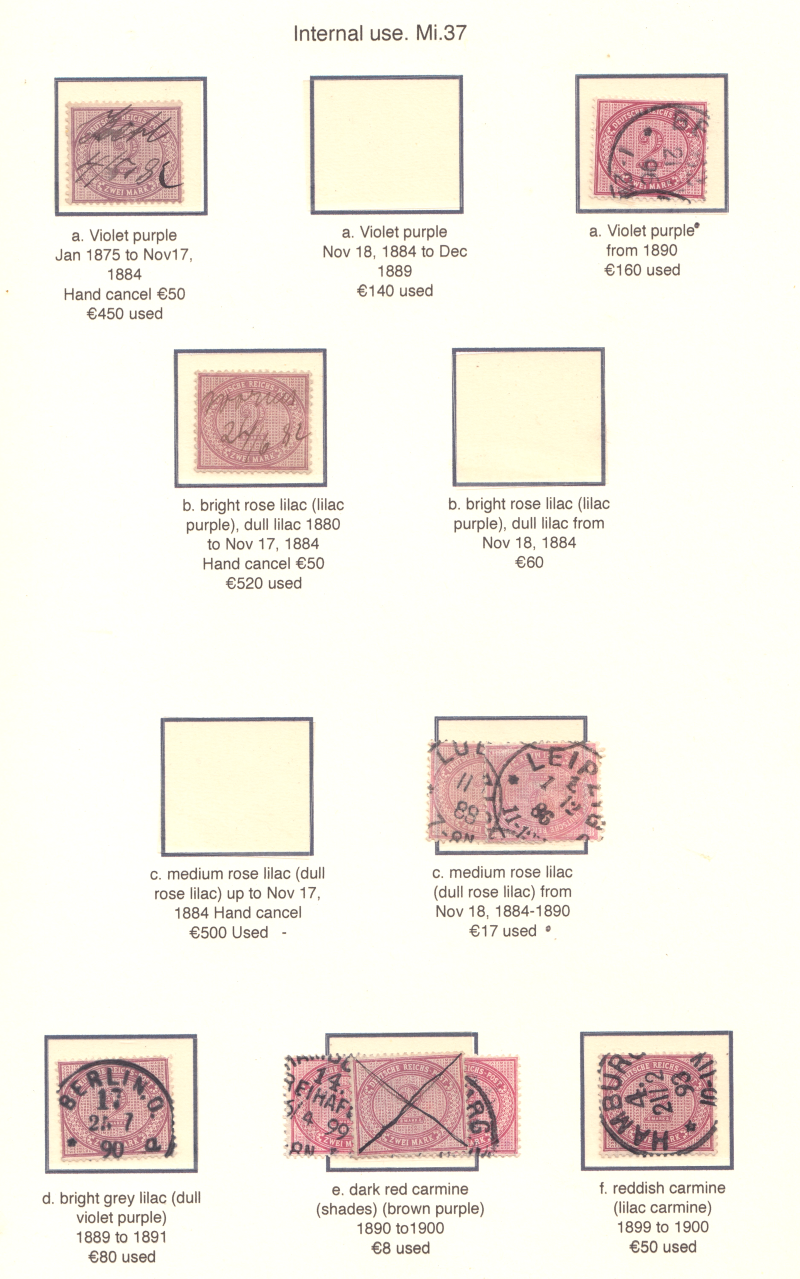
Here are additional Mi.37 stamps, with a breakdown of the CV for issues distinguished by date , shade and cancellation.
This stamp was issued on January 1st 1875 for use only on internal official mail.
Numerous colors are available due to subsequent printings over the 25 years this stamp was in use. The color varieties can be difficult to distinguish without cancel dates.
Pen cancellations (hand cancellations) were required until 17 November 1884. While I cannot be certain that every example has been identified correctly, the dates do provide useful guidance. The shades shown here are consistent for the different issues.
Here is a page of PFENNIG,1880, Mi.39 to Mi. 44 that I have collected
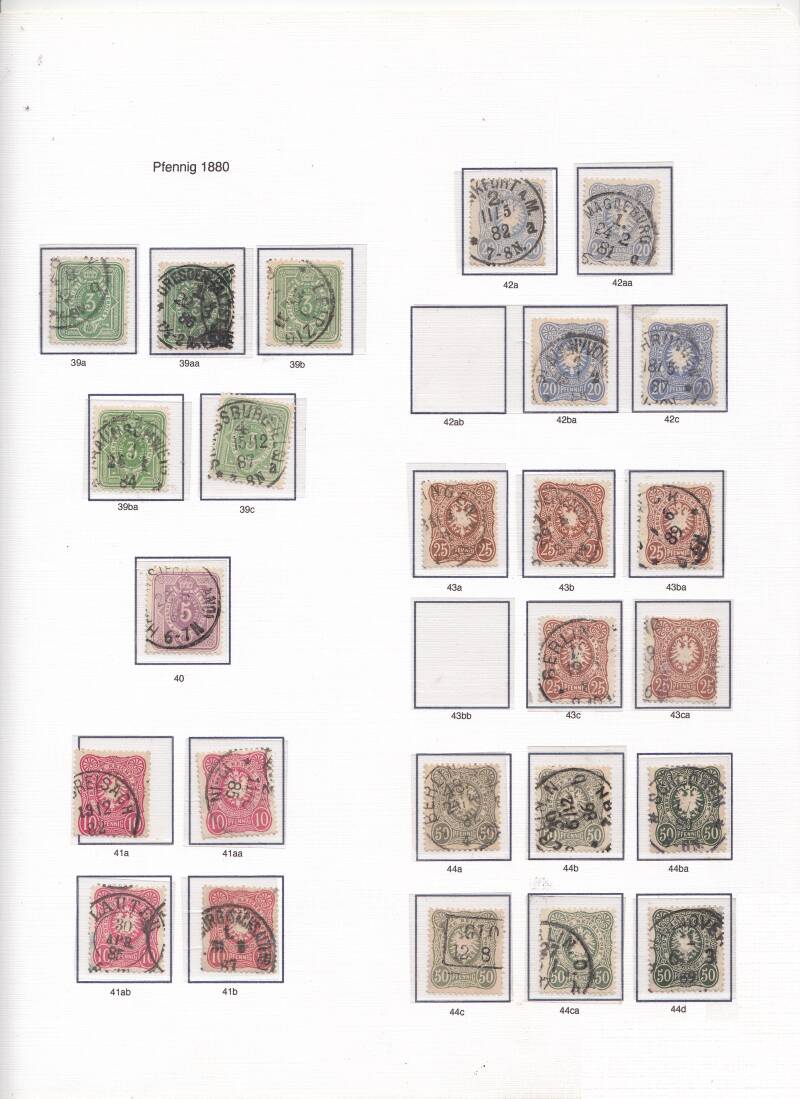
All the above are proofed.
Below is a copy of the CVs for the various issues, adapted from Michel.
The I and II designations in the headings refer to earlier and later printings.
“I” Suffix — Up to approximately 1884, colors tend to have a more matte finish, and the gum is yellowish with fine cracks. Through to approximately 1886, considerable variation may be found in the paper and colors.
“II” Suffix — From late 1886 onward, gum, paper, and colors remain variable; however, the colors are typically richer and somewhat glossier, with a smoother overall appearance and mostly white, glossy gum.
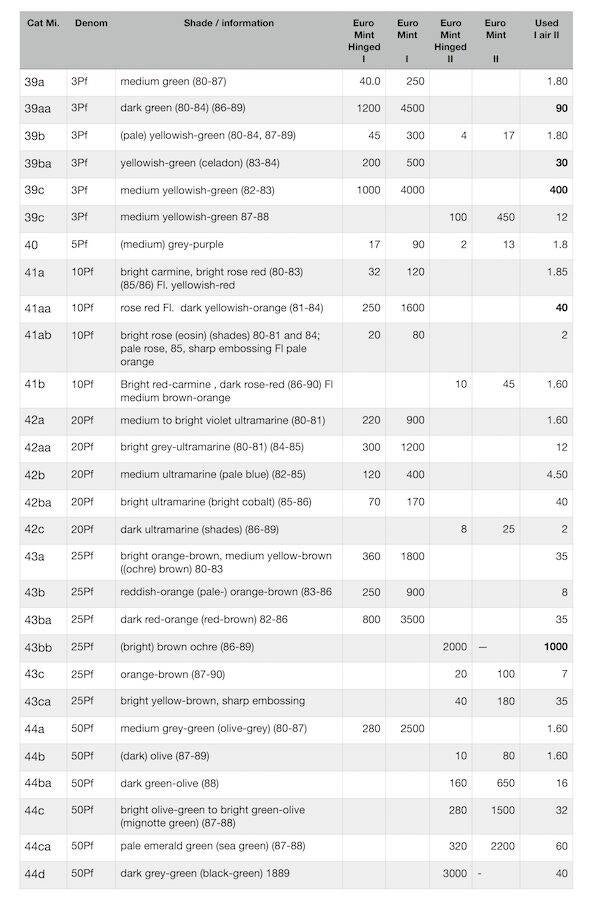
It is interesting to compare the Michel and Stanley Gibbons (SG) estimates.
There are less shades designated by SG although they do distinguish two shades fro the 5PFENNIG (Pf) over the one from Mi.
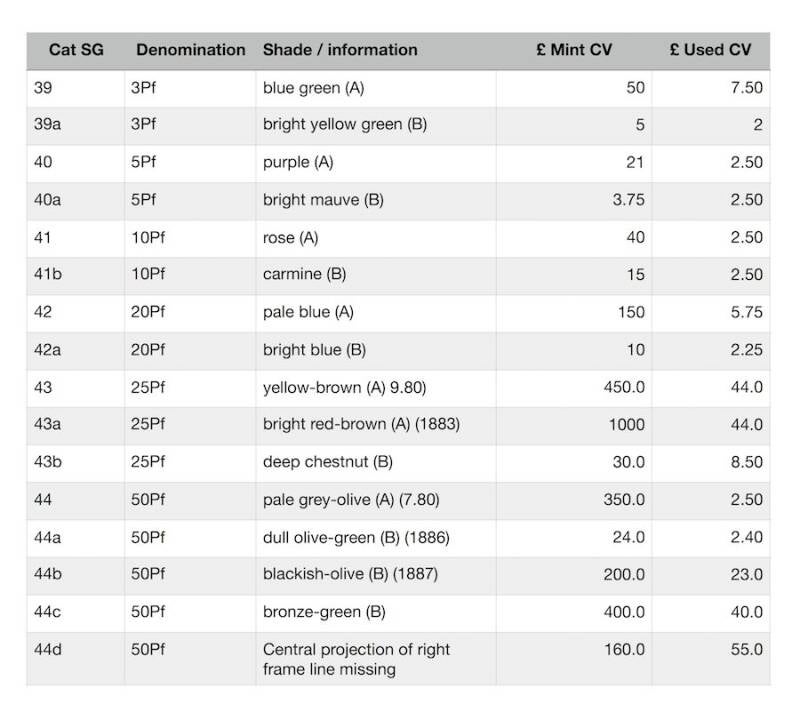
Many of the scarcer shades carry high catalogue values and are well worth seeking out.
Particularly desirable are the cancelled Mi.33aa, Mi.39C, Mi.41aa, and Mi.43bb.
Please note that many mint stamps also have high catalogue values in shades other than those listed for the cancelled issues.
Of course the main problem is how to find and certify them as genuine shades.
The so called Krone / Adler (Crown and Eagle) definitive stamp series was issued by the German Imperial Post (Reichspost) starting on October 1, 1889.
Design Overview
- Central Motif: The design features a prominent Imperial Crown (Krone) at the top center, flanked by ornamental framing, resting above a central shield displaying the German Imperial Eagle (Adler).
- Typography: The face value and currency designation ("Pfennig") are clearly displayed in clean, legible lettering framed by structural scrollwork and geometric borders.
- Graphics: Designed by graphic artist Schilling, the typography and frame layout varied slightly across values to accommodate single or double-digit denominations.
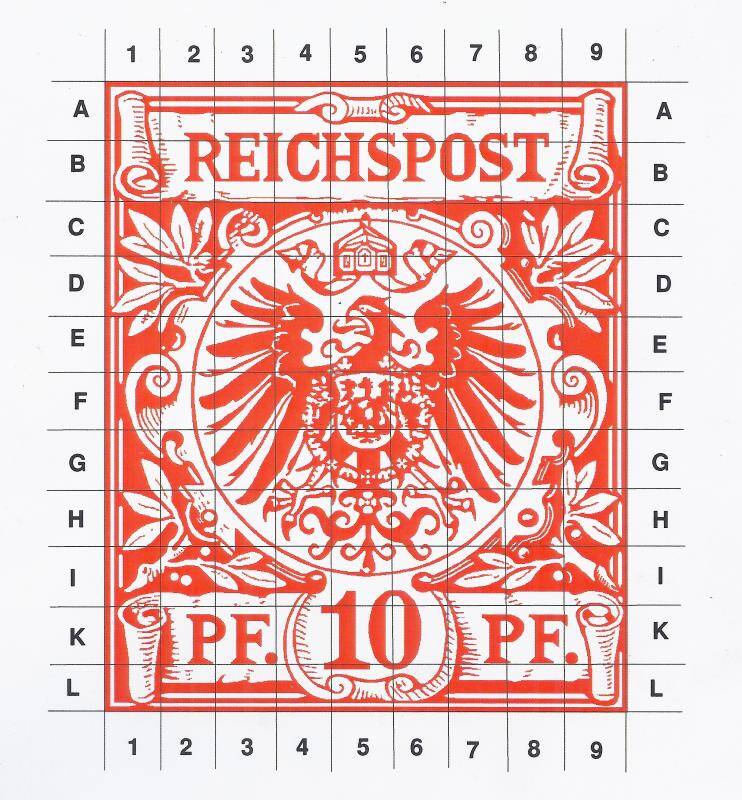
Diagrammatic representative mentation of 10PF Krone / Adler (Crown and Eagle) stamp.
The 1-9 and A-L boxes define areas where flaws can be identified and will be discussed later.
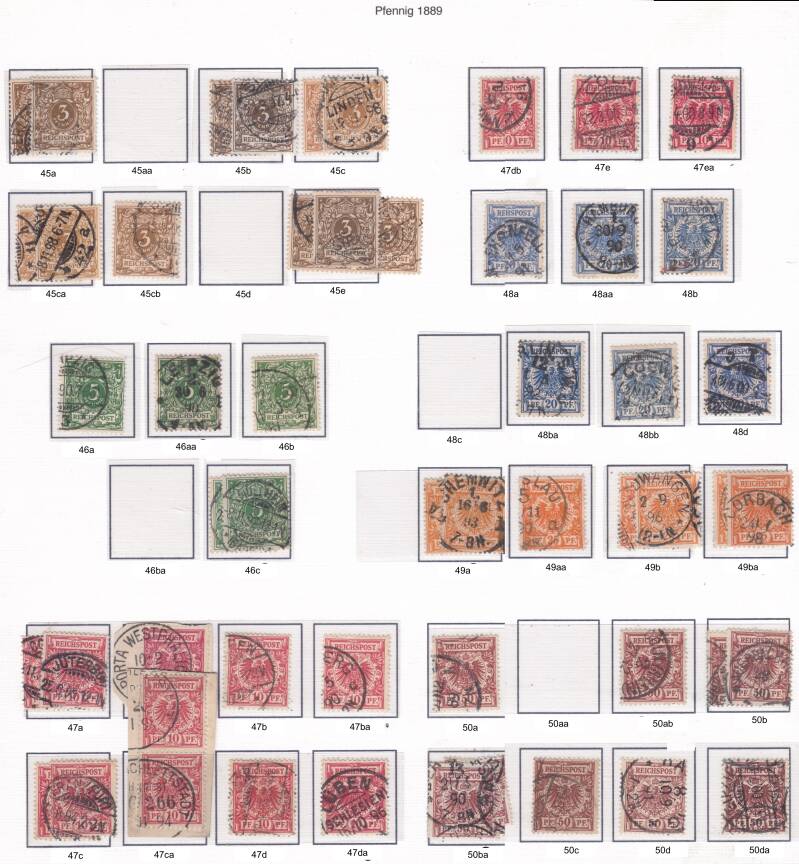
Here is a page of the 1889 stamps Mi.39-Mi.44. All proofed.
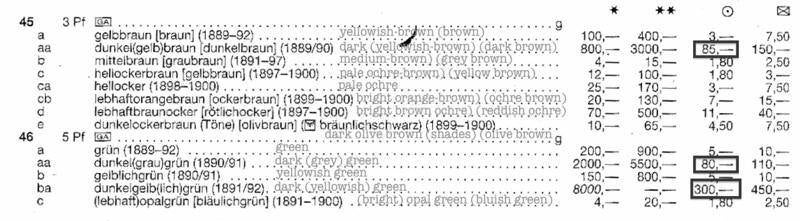
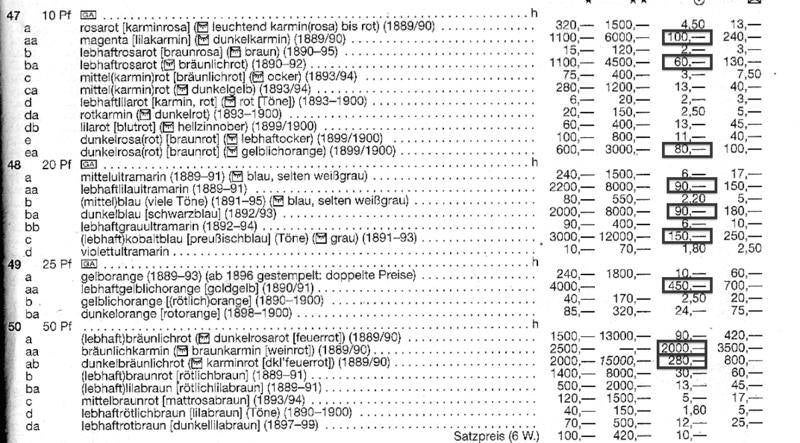
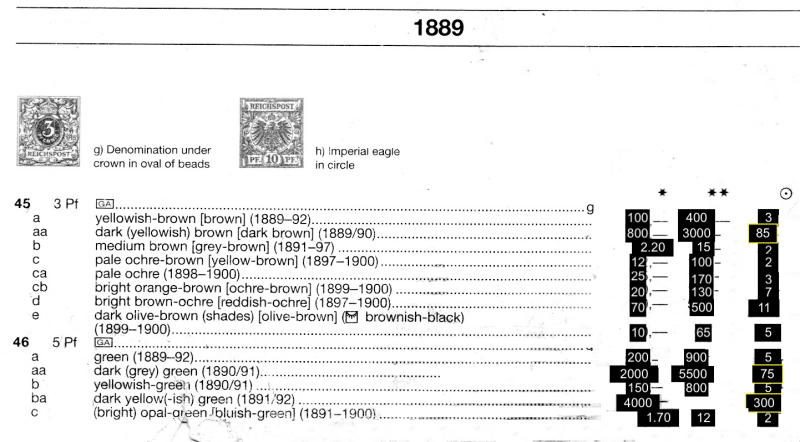
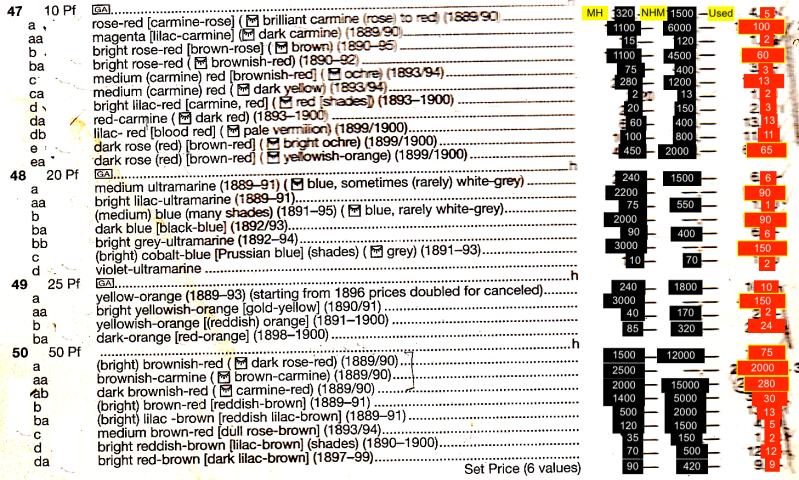
The tables below show CV values based on Michel, using both the German edition and the English-language version.
I initially added English translations in grey to the first German table for the 3pf and 5pf stamps. However, this was not practical for the 10–50pf values. The English tables therefore translate the shades listed in the German tables by cross-reference. Prices for covers bearing the various shades are shown in the German tables.
The tables highlight the significantly higher CV values for NHM and HM stamps compared with cancelled examples. Some cancelled stamps are boxed in the German tables; it is reasonable to assume that these may be obtainable at more affordable prices.
Please note that UV light excitation is required to test the emission colours used to identify shades. This is indicated by a boxed symbol followed by the excitation colour.
Accordingly, it is worth confirming scarcer shades and having examples that have already been authenticated—preferably with recent certificates—can be a great help.
Mi.45 to Mi.50 table of CV for various shades
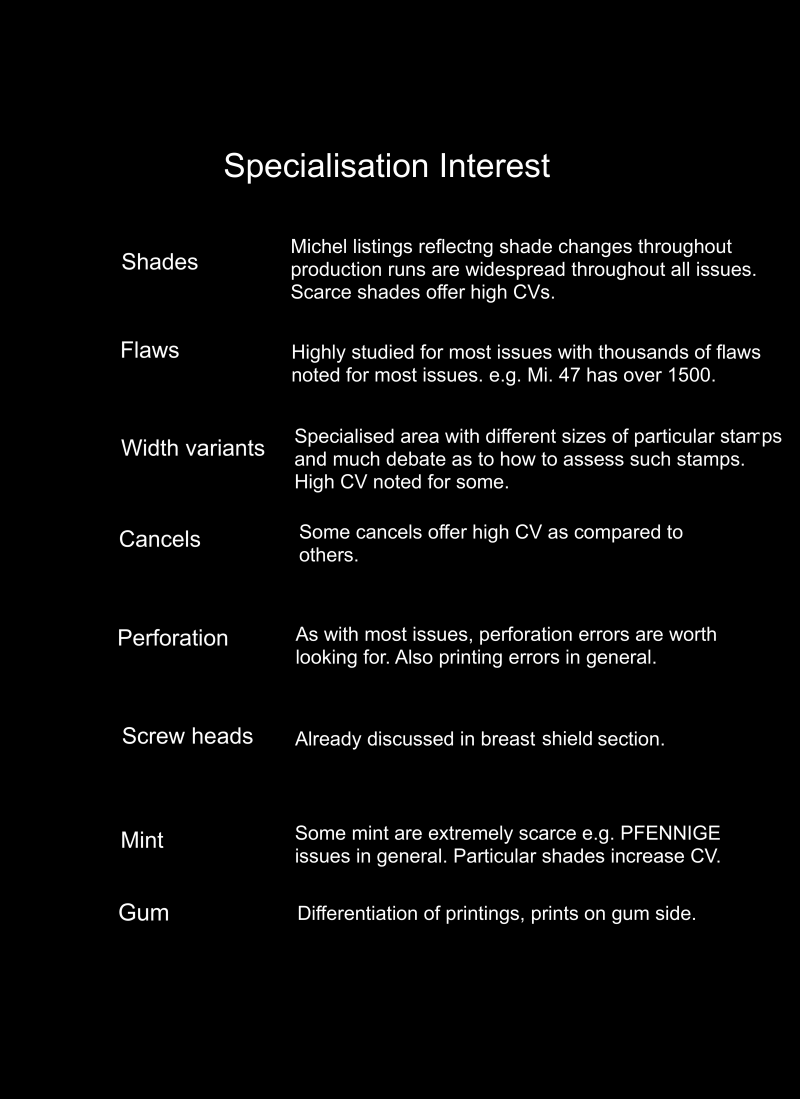
Before examining shades in greater detail, it is important to consider several specialised areas when assessing stamps issued between 1875 and 1899.
Careful attention to these details can make such studies particularly rewarding.
These areas include:
Width variations
(see: Germany 1875 to 1900 stamps - perforation & paper varIants.
https://www.stampboards.com/viewtopic.php?f=17&t=82738
This contains a great wealth of discussion concerning the reason for different width stamps and as such is rather unique for this subject.
Flaws
see: Germany: plate flaws of 1889 Krone/Adler 10 Pfennig issues.
https://www.stampboards.com/viewtopic.php?f=13&t=51082
This is a vast and highly specialised field. Dedicated handbooks identifying flaws have been produced, particularly for the Mi.45 to Mi.50 issues.
For example, Mi.47 alone has more than 1,500 listed primary flaws and varieties.
Accordingly, this area requires considerable knowledge, research, and attention to detail.
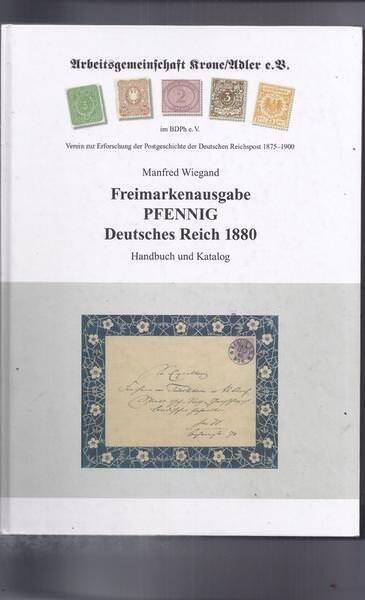
I will outline some of the key principles involved, limiting the examples to those illustrated in Michel and referring to another excellent book on the 1880 issues shown below
Paper thickness
Perforation oddities
Assessing shades
Michel’s shade descriptions can be confusing, and the English translations are often of limited help.
Expertised examples are essential if the full CV is to be realised.
Self-assessment is often the only option, but it requires a substantial number of stamps for comparison. This is usually most practical with the more affordable issues, such as Mi. 47, where shade and flaw varieties can present an interesting challenge.
Cancelled stamps are generally less expensive. However, mint examples are preferable because they are typically in better condition and are unaffected by cancellation marks that may alter the apparent shade. Unfortunately, obtaining enough mint stamps to provide a statistical chance of finding the rarer shades can be prohibitively expensive.
Even stamps that were expertised many years ago can be problematic, as ageing in poor storage conditions can drastically affect their shades.
Michel publishes a colour guide.
Example pages are shown below.
We are faced with different computers and screens now so this all look different for various viewers.
They do give an overview of the naming of colours and show just haw similar some are.
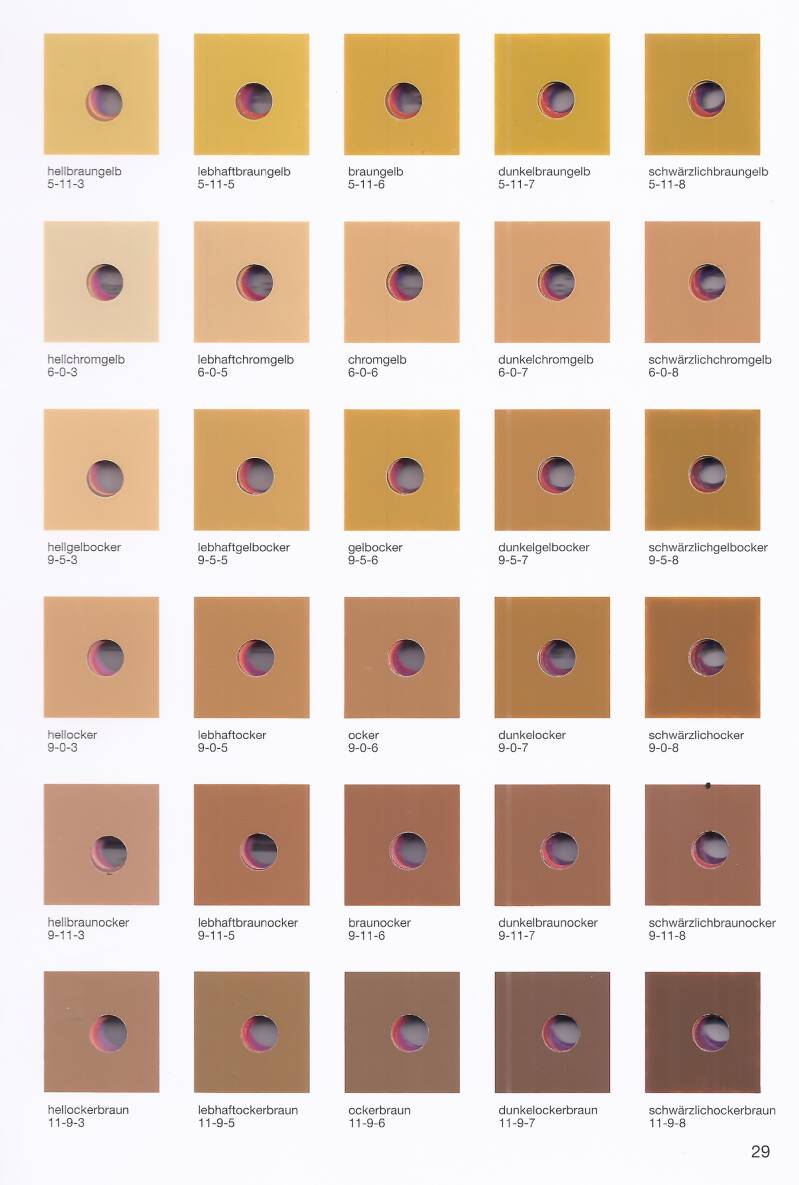
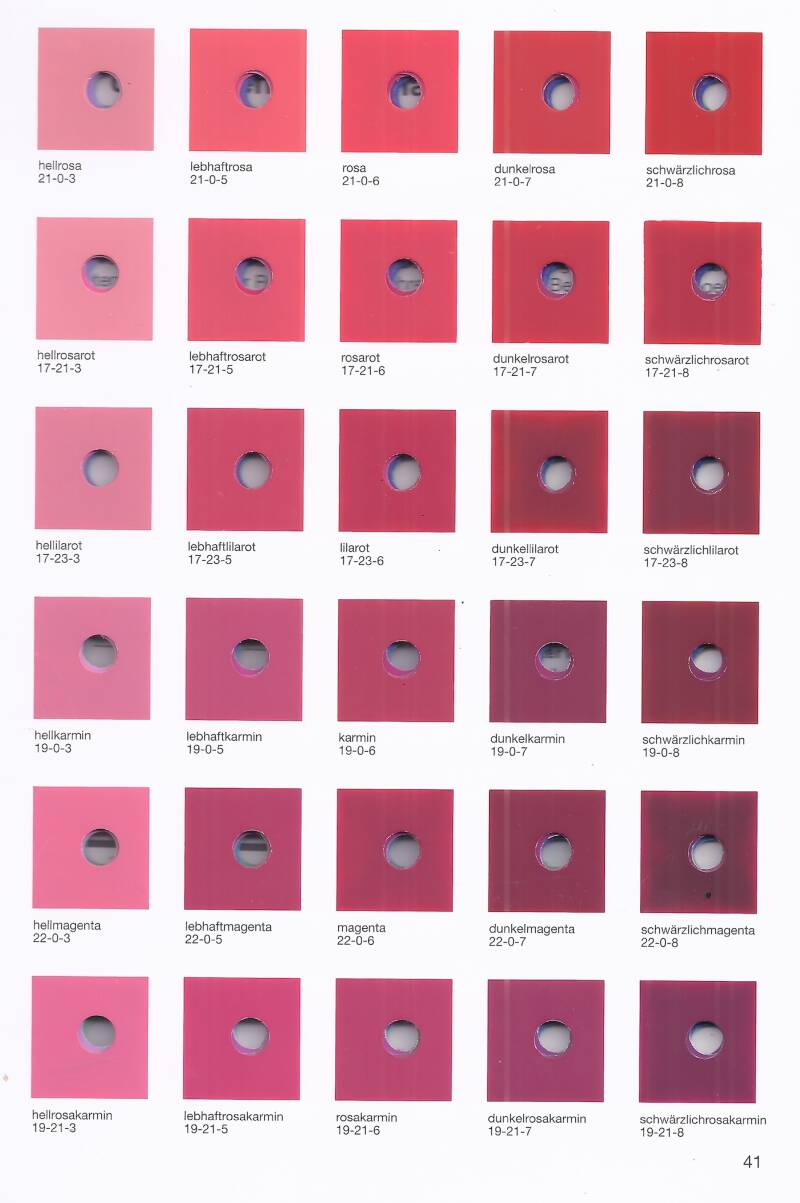
The traditional approach is to place a stamp beneath a shade guide and move it until the stamp appears to match the guide.
However, when the guide is presented in book form, this can be difficult to use effectively.
Unfortunately, stamps often have complex designs with few large areas of solid colour from which to judge the shade.
I will describe a useful and easy method for the comparative assessment of stamp shades.
This method does not identify a precise shade. Instead, it compares how scanned images respond when exposure, contrast and brightness settings are adjusted.
These adjustments can highlight similarities, allowing stamps to be grouped according to their response.
If proofed stamps are available, they can be included in the scan and their response compared with that of the other stamps.
All stamps must be included in the same scan, at 600 dpi.
In practice, the image settings are adjusted using the computer mouse, usually with sliding controls, while the results are assessed visually. The aim is to identify points at which differences in shade become apparent. Where a large number of stamps is available, this can be particularly rewarding: lots may be divided into two or more groups according to shade differences. Over time, these groups may begin to correlate with published shade descriptions.
Cancellations can also be helpful. Where issue dates for particular shades have been published, certain shades may be attributed only to stamps with corresponding cancellation dates.
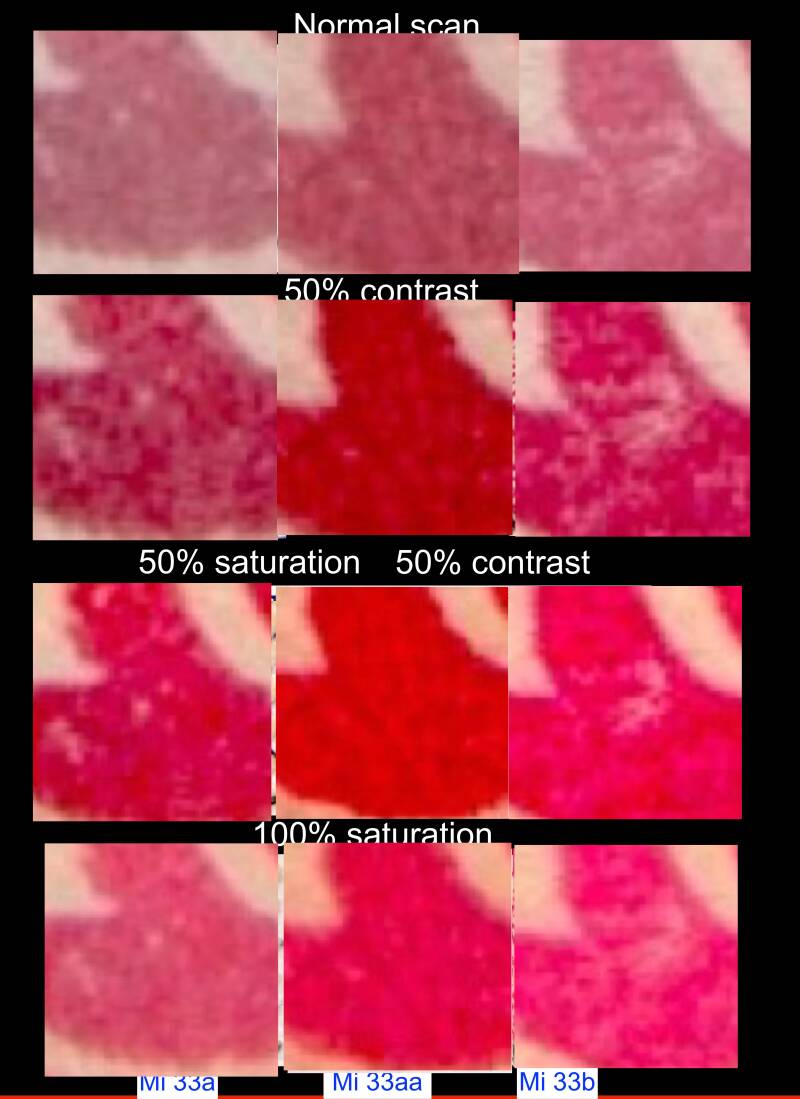
The next figure shows the effect of altering computer settings on three 10 PFENNIGE (Pfge) examples, all proofed.
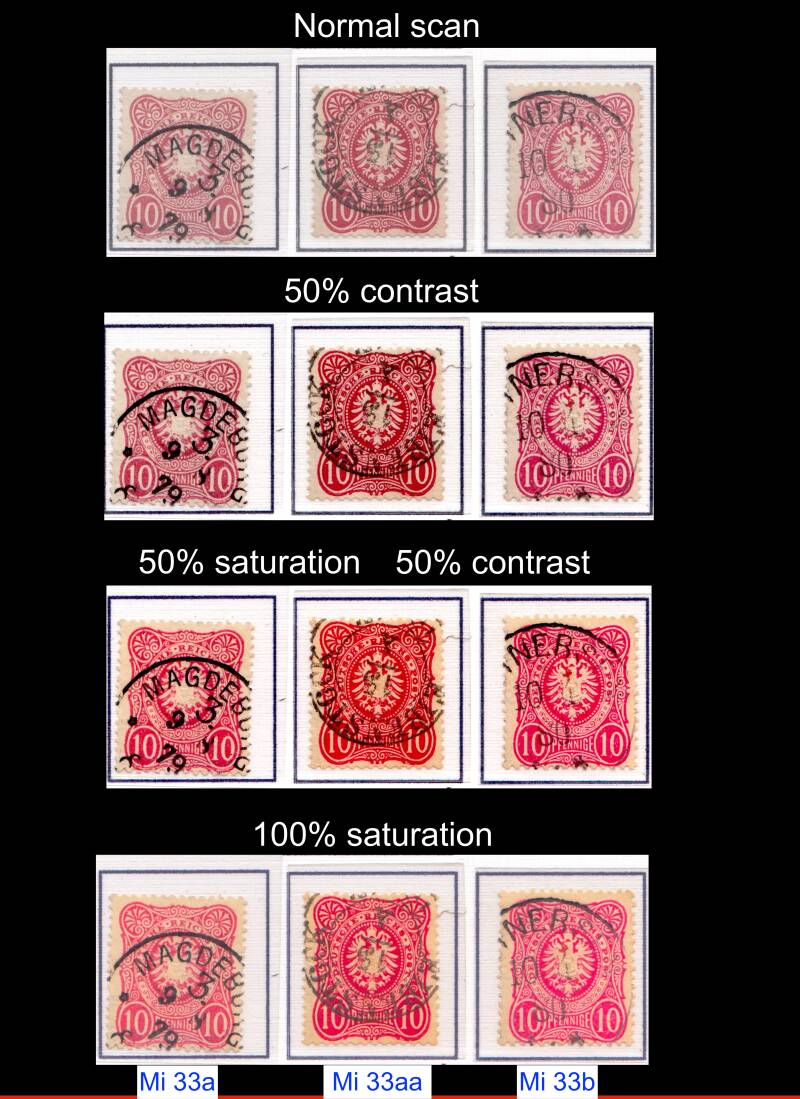
In the normal scan with no manipulation the 33a and b seem similar and the aa darker. A better by eye examination in daylight might improve the discrimination.
50% contrast shows a better distinction of the shades. The 33aa stands out. The 33b is darker pink as compared to the 33a.
50% contrast and 50% saturation. Again the 33aa stands out as bright red.
100% saturation. 33aa redder, 33b pinker than 33a.
Here is a reminder of the Michel details. Please note the high catalogue values for MI.33aa.
Also note the colour descriptions translated from German—the “blood red” designation stands out.

The shades I am illustrating may appear differently on various monitors. This is a drawback in illustrating one´s findings however, altering the various computer settings in investigating your own stamps may help in defining their shade.
One can even zoom in on selected areas and try and see more deal of the distribution of the ink pigments.
Here, as an example, are the reasons chosen to examine.
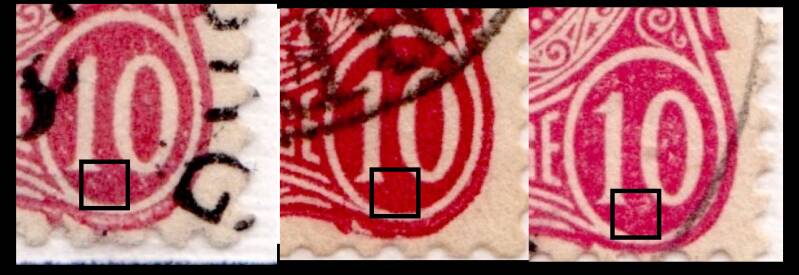
Below are enlarged sections selected for the various analyses.
Later, I will provide clearer examples of how enlargement techniques can be used to assess ink-pigment distribution in stamps from later periods.
It is also worth considering how shade variations should be documented: do they reflect abrupt changes in printers, or were they created more gradually through the routine mixing of inks during the printing of an issue? The former is more likely to produce distinct, abrupt shade differences associated with a specific change or date at a printing house. The latter may instead reveal a gradual drift or fluctuation in subtle shade variations.
Width Variants
This can be a highly rewarding area of specialisation. Michel provides clear definitions and examples of width variants.
In my referenced Stampboards.com thread, ´Germany 1875 to 1900 stamps - perforation & paper variants`, mentioned above, there is extensive discussion of Michel’s definitions, including what should be measured and how those definitions relate to the perforation devices in use at specific times. It is well worth reading.
Here is a breakdown of the Michel definitions of width variants
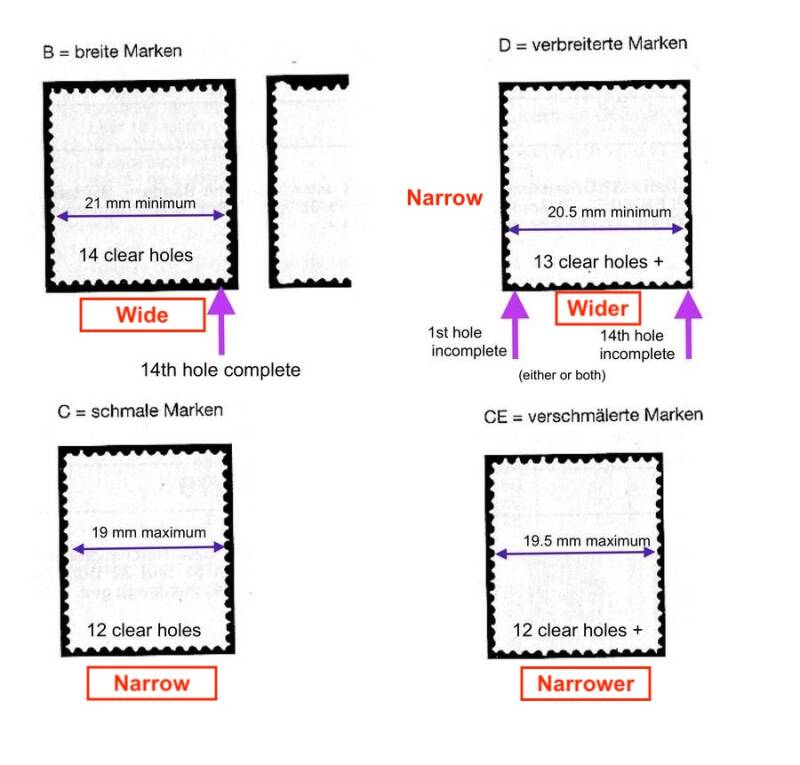
The German text has been translated, and the widest stamps are designated WIDE, while the narrowest are designated NARROW.
Some confusion arises when stamps are not of standard width but are slightly wider (WIDER) or slightly narrower (NARROWER) than normal. This prompted discussion and the compilation of data in the thread, focusing on how to define a ´normal` stamp and determine which perforation machines were used for the various issues.So,
- B = Wide = breite
- C = Narrow =schmale
- D = Wider = verbreiterte
- CE = Narrower = verschmälerte
The stamps were perforated via vertical comb perforation.
The perforated sheets consisted of two counter panes of 100 stamps each whose vertical rows were perforated from left to right. The perforation comb was vertical and the sheets pushed under them in a horizontal direction.
Due to the malfunctioning of the mechanism which moved the sheets along - i.e. the incorrect insertion of the sheets (six sheets were laid on top of each other for simultaneous perforation) - wider or smaller stamps were created.
Small stamps measure 19 mm as a maximum and are sometimes under 18 mm so that the stamp design itself is perforated. The comb, which initially and later sporadically had 13 needles, was usually 14 needles and each punch of the comb hit into the 14th hole of the preceding punch. If the comb did not hit the 14th hole, but to the right of it, a wide stamp was created which has a width of at least 22 mm as measured from the low point between the perforation teeth. In very rare cases, the 14 hole comb jumped the width of another hole and thus created a wide stamp with 14 holes and a small straight edge. These stamps are square and even wider than they are tall.
Additional printing details
Significant horizontal misperforations are known, although they should not occur with vertical comb perforation.
Because the sheets were inserted manually, incorrect placement should have been noticeable, making these errors surprising. One possible explanation is that the six inserted sheets had margins of varying widths. In that case, the stamp designs would not have aligned precisely, resulting in the observed misperforations.
Beginning in 1880, the “Pfennige” series was gradually replaced by the “Pfennig” series. The new issue had no official first day of use; stamps were introduced as supplies of the “Pfennige” issue were exhausted. The reasons for issuing the “Pfennig” series have already been discussed. The same information regarding sheet arrangement, plates, and printing applies to the “Pfennig” issue. Marginal inscriptions appear in this series, initially only rarely but with increasing frequency in later printings.
From 1886 onward, during the final years of production, most stamps were printed in four-sheet formats. It is assumed that, beginning in 1887, an automatically applied sequential six-digit sheet number was printed in the center of the four sheets. When the sheets were subsequently cut apart, these numbers were divided, so that only part of a number appears in the margin. Corner pieces from late printings with such partial numbers are occasionally found.
Postal clerks frequently removed margins before use, making used margin pieces with plate numbers difficult to find.
The “Pfennige” issue remained valid throughout the period of the “Pfennig” series, and both issues remained valid until January 31, 1891. Very late usages are occasionally found.
Beginning in March 1877, the color of the 50 Pf stamp changed from gray to various shades of green. Unlike the pronounced color variations found in some other denominations, this change was intentional. After that date, gray stamps were used only infrequently. However, like the other values, they remained valid until the end of January 1891, making a gray 50 Pf stamp with a late usage date an exciting find. A few late usages are known from 1880, including one dated March 17, 1881. The ultimate find would be a mixed franking featuring the gray 50 Pf stamp together with its counterpart from the subsequent “Pfennig” series.
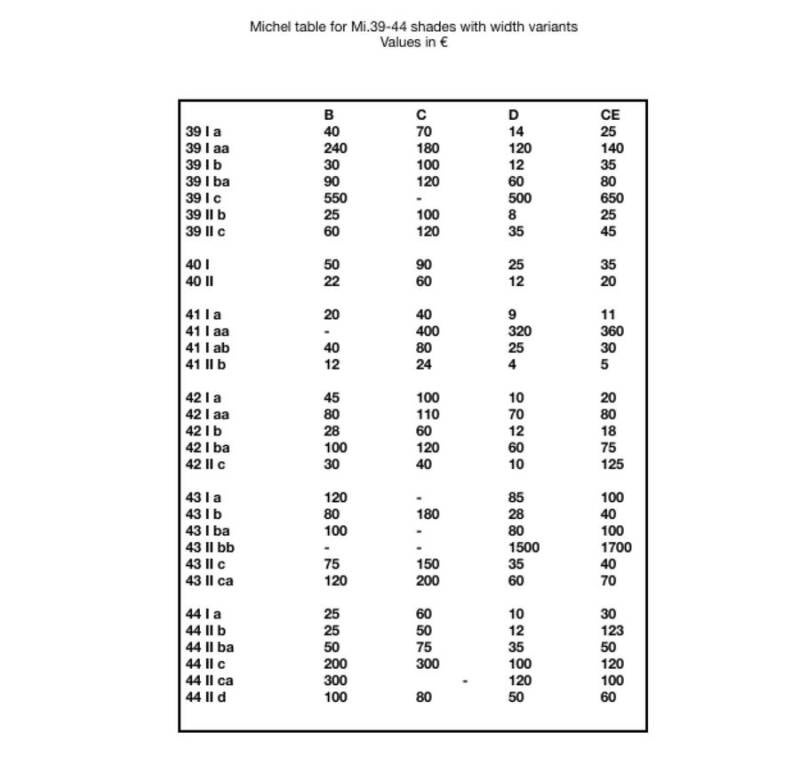
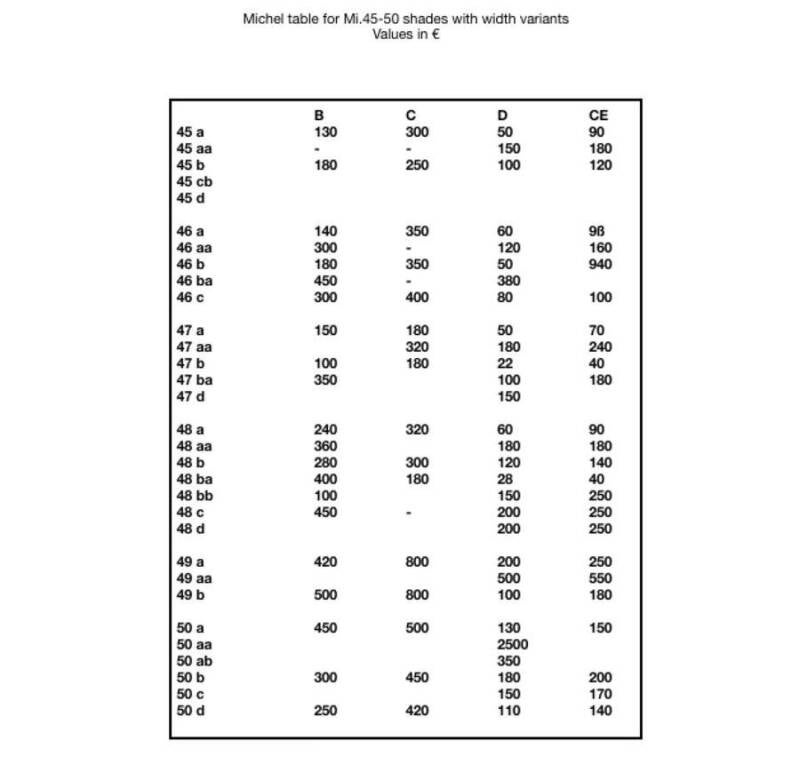
I am adding the Michel CV tables for the variants of width for Mi. 31 to Mi.50 stamp Varieties
Note the increase in scarcity and reflected high CVs even for some stamps where the normal CV is low.
Examples are well worth seeking out and I have always found a good number in bulk lots where original owners did not examine them for their width properties.
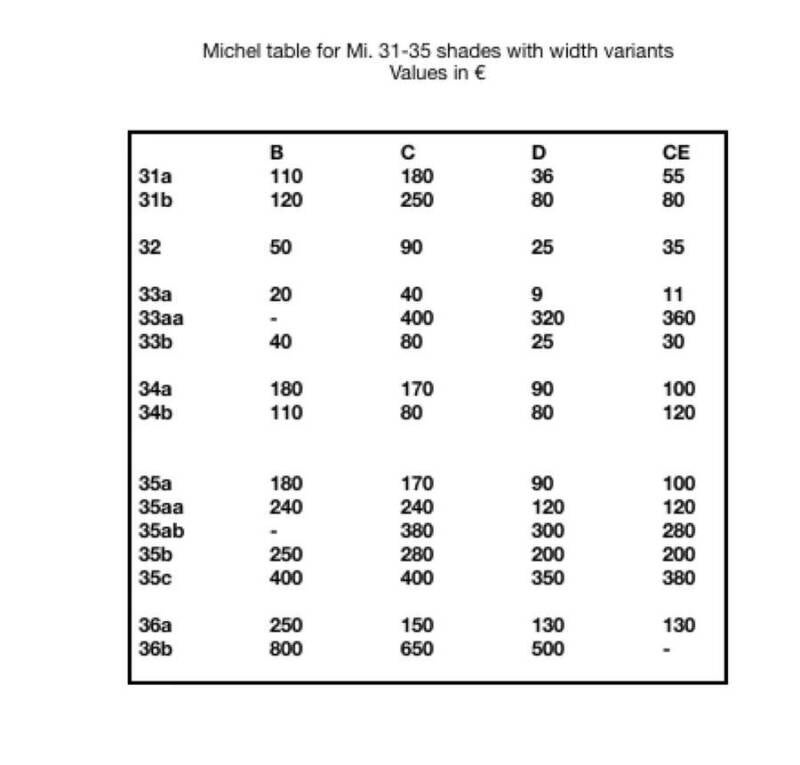
- Generally the ´B` and ´C` widths command a higher CV.
Measurements
The stampboards.com thread quoted above contains extensive discussion of the validity of Michel’s method for identifying width varieties. It examines the use of different perforators over time, variations in perforator hole sizes, variation in the perforation regularity and includes considerable data generated to investigate these issues.
Accurate perforation-to-perforation measurement is essential.
Michel recommends counting the perforation holes at the top and bottom of the steps as a guide. However, the discussion noted that counting the stamp teeth may provide a more reliable basis for examination.
The central question is whether the ‘D’ and ‘CE’ widths are genuine outliers from normal stamps.
Many expertised examples—including several in my own collection—were certified many years ago.
I question whether those measurements could have been made with the same degree of accuracy now possible through modern scanning technology and computer-assisted measurement.
I use a Mac computer and a free program Inkscape.
Using stamps scanned at 600 dpi a stamp can be enlarged comfortable and the distance as shown below measured accurately.
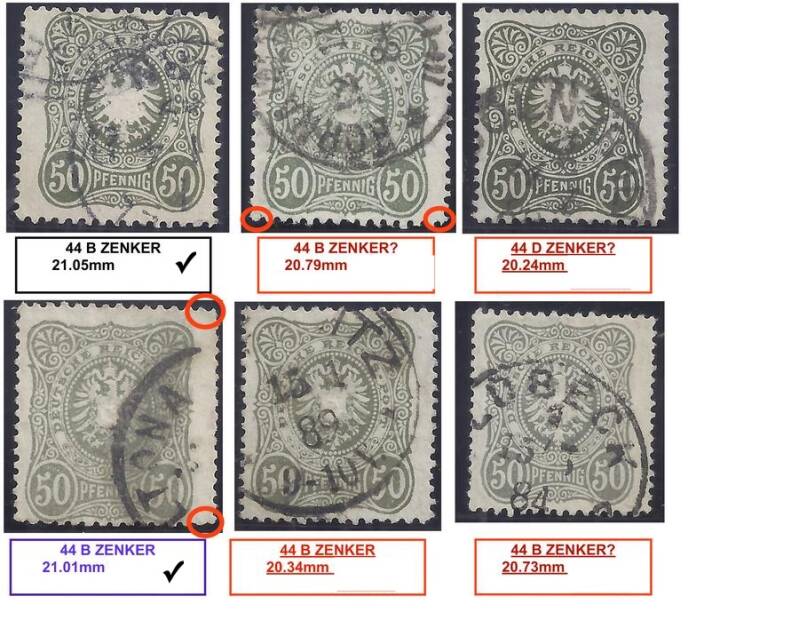
Below are two stamps showing measurements n both proofed by ZENKER and fitting the criteria for Wide stamps ´B`.
No problem as they fit the Michel definitions.
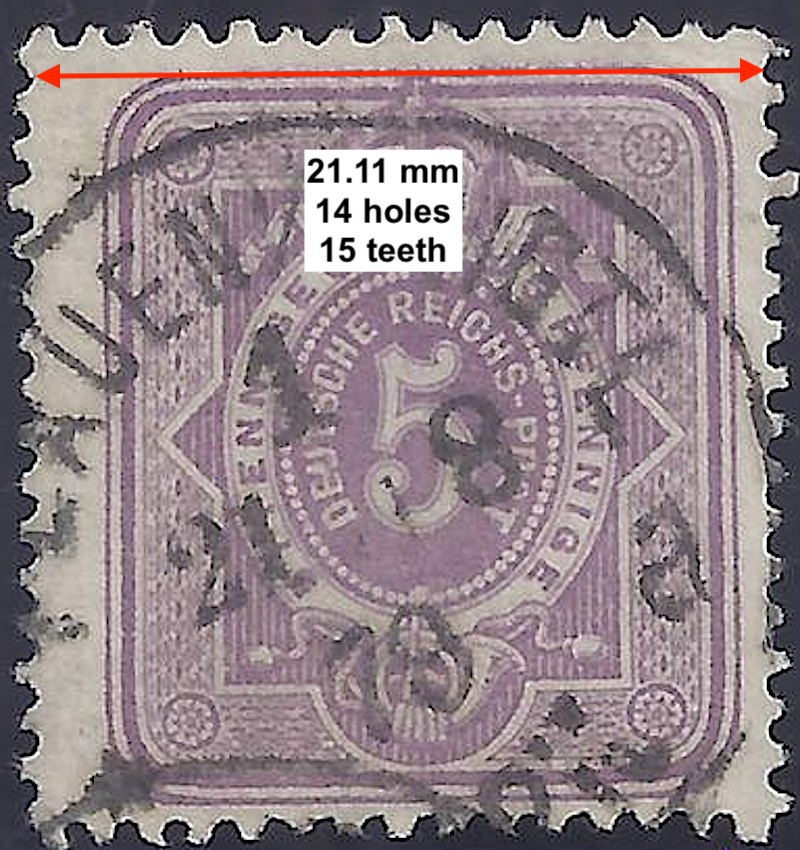
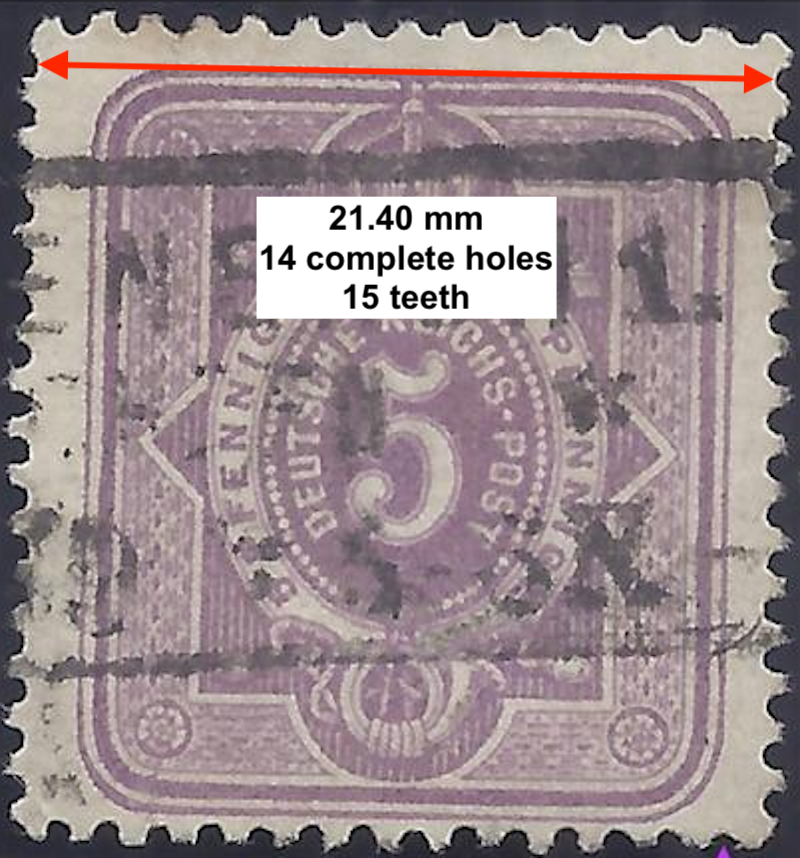
PFENNIGE Mi.32 examples (CV €50).
Here are two Mi.32 samples proofed for wider ´D` stamps.
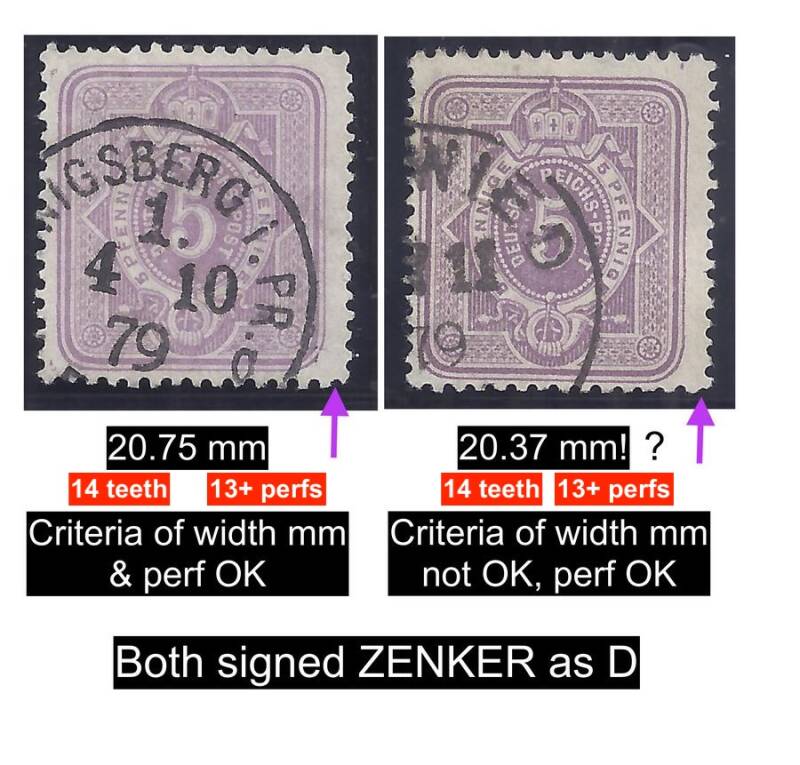
Mi.32 wider stamp left meeting Michel criteria, Mi 32 right failing criteria in distance between perfs.
Note that both have only 14 teeth as. compared to the ´B`examples shown.
Below are proofed stamps supposed t ´C`examples
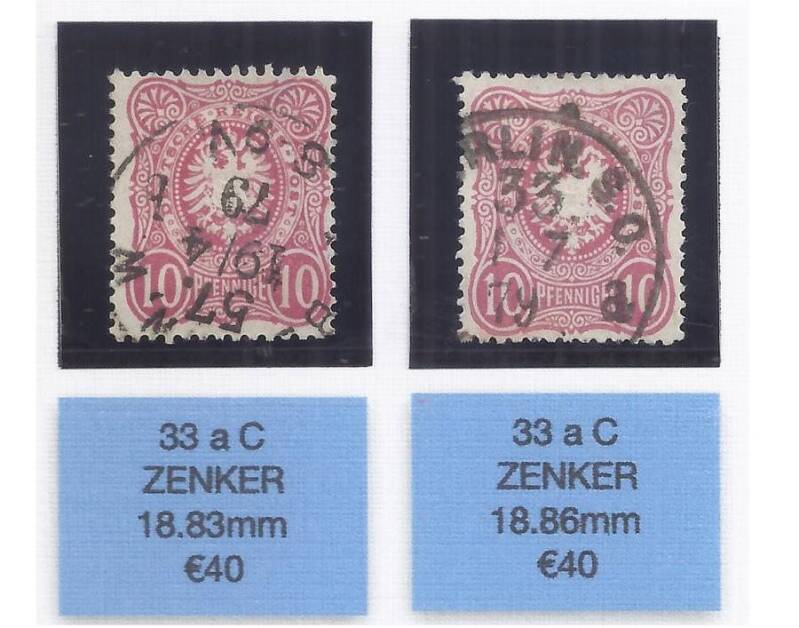
Both are proofed and fit the criteria for width (less than 19 mm) and have 12 perforation holes with 13 teeth
Here are two more examples
Below are two more examples both proofed that cause a small problem with the Michel measurement between perforations criteria.
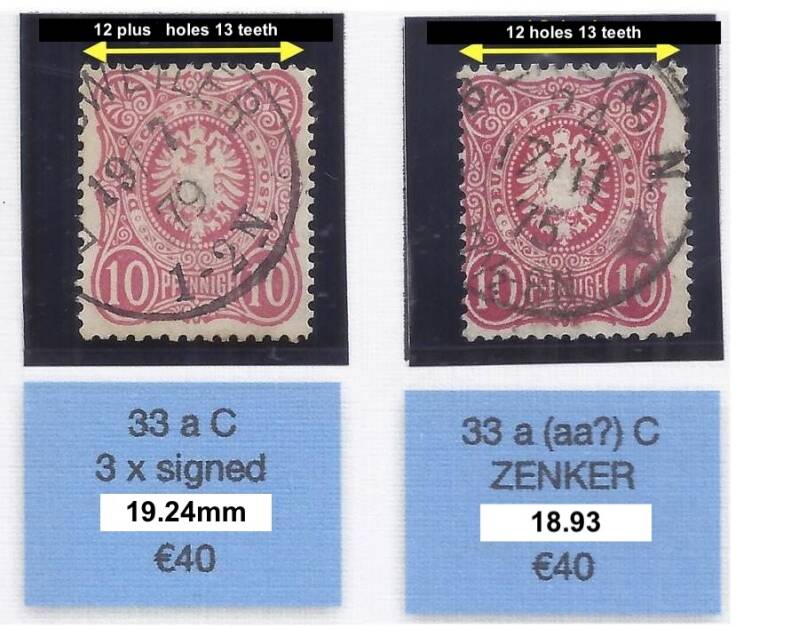
The left stamp is narrow but does not fit the less than 19mm for a ´C` although proofed three times! It should be defined as a ´CE`.
The right stamp fulfils the Michel criteria for a ´C`.
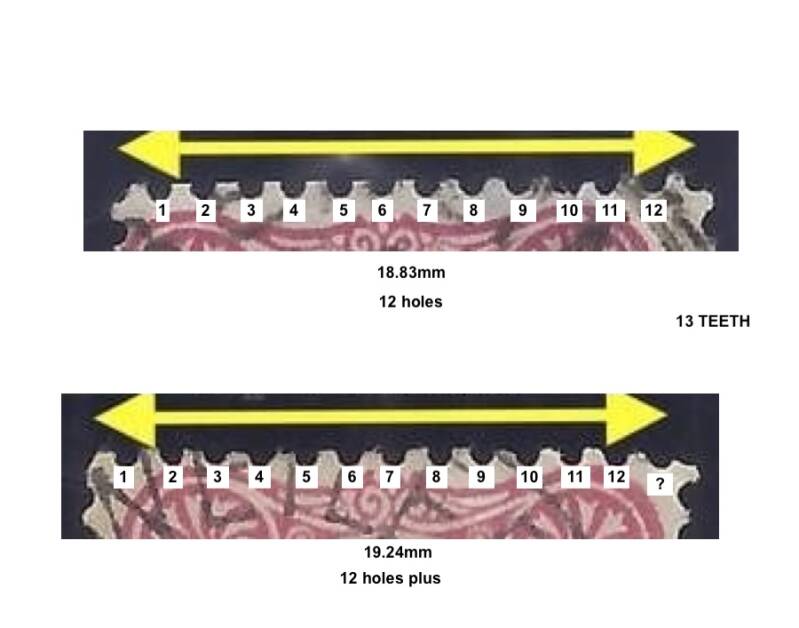
The slight difference is shown below looking at the perforations in detail.
The 19.24 stamp has a 13th smaller hole, hence the plus notation.
So strictly abiding by Michel criteria and looking at the detail of the perforations the proofed ´C`should be a ´CE`.
I find that the distance measurements and a close inspection of the oerfoattions are best in determining the width even accounting for any shrinkage or alteration in the stamps structure since the time of the original proofing.
More examples showing proofed stamps as ´B`but with perf to perf distances undertone 21mm making the ´D`.
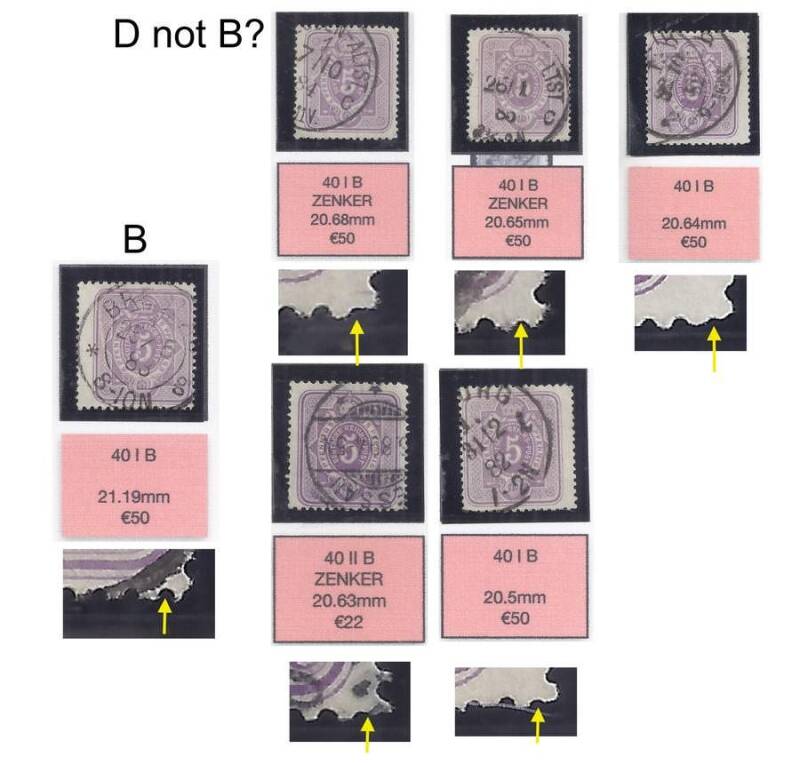
Here are some more examples where the perf to perf measurements are less than in the Michel criterion for ´B` for four of the stamps.
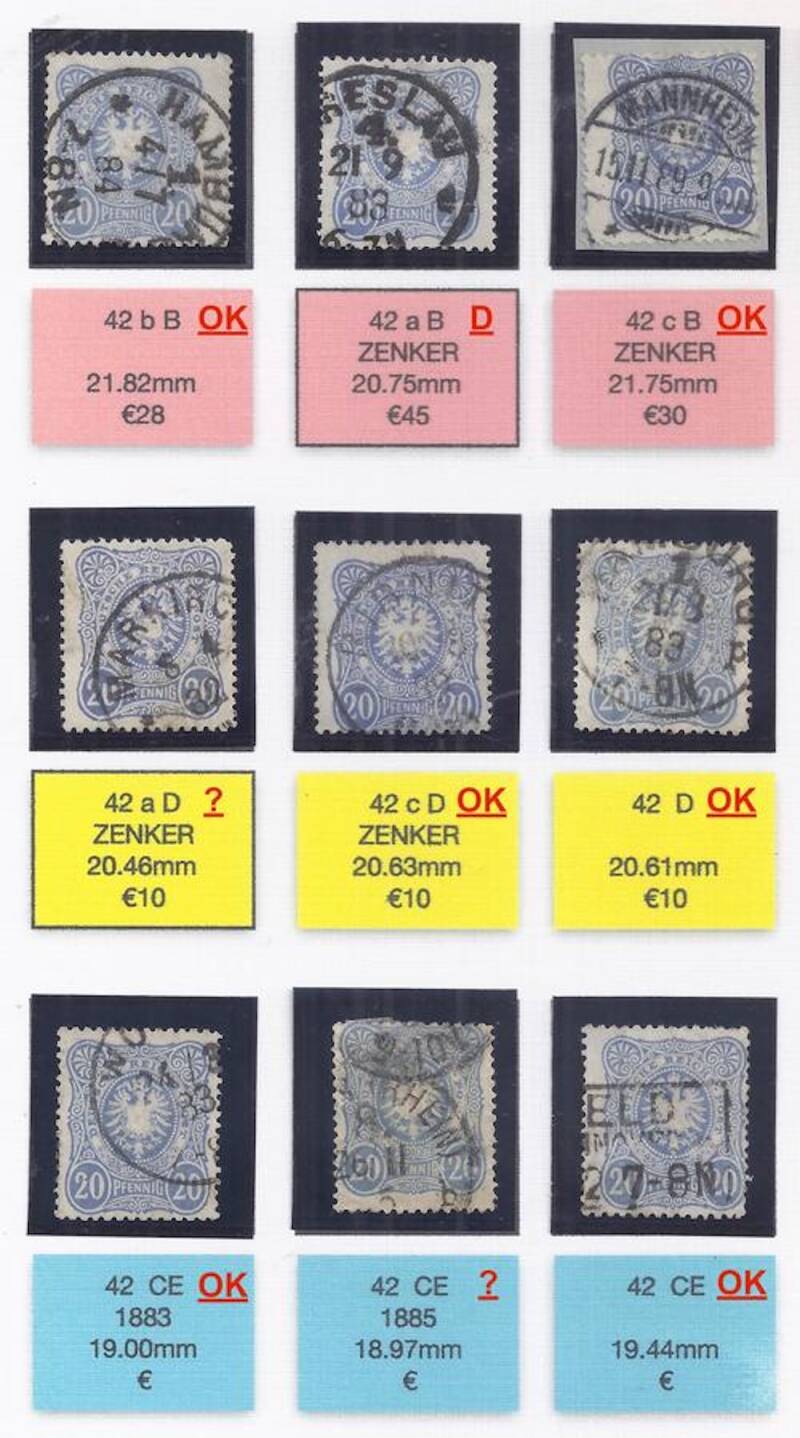
More examples. Here we do have proofed ´D`stamps as well as ´CE`. One stamp proofed as a ´CE`should be a ´C`based on perf to perf measurement.
I sold many of my width variants some time ago. However, delving Ito my remaining stocks I Fons many more. The point is it is worth evaluating stamps for their width. The ´B` and ´D`stamps tend to stand out more as they are generally froth left of the pane and have a large margin. The ´C`stamps look generally very thin and a distance measurement solves whether they are ´C` or ´CE`.
Despite the discussions on the perforation holes and teeth, I find that measurement is the best diagnostic tool for discriminating width variants.
Please look at the severally times quoted link https://www.stampboards.com/viewtopic.php?t=82738&start=100 for a superb ride through the investigation of width variants.
B- 21mm minimum
D- 20.5mm minimum up to 20.9mm
C-19mm and less
CE- 19.1mm to 19.4mm
Normals 19.6 to 20.4 (determined from 600 stamps)
So starting with a mother load of stamps purchased cheaply (as below) we can seek out possibilities using measurement s of computer scans. One can easily ´zoom`along and identify possibilities the check temagain more carefully.
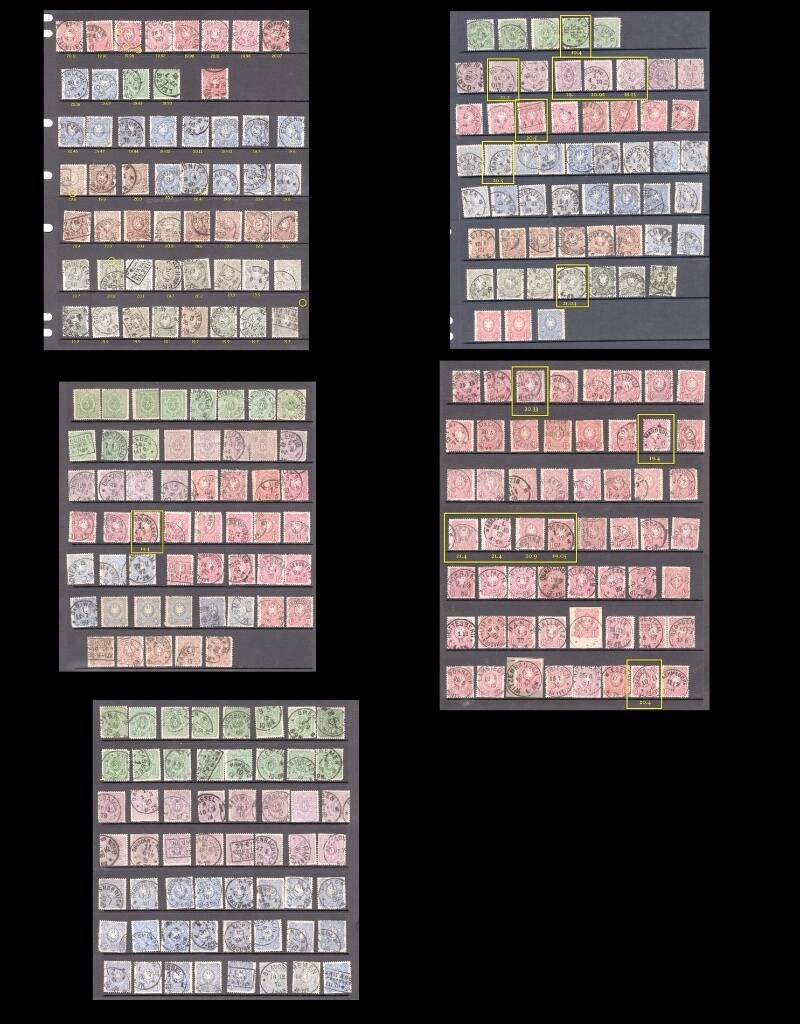
Below are candidates for width variants selected from bulk lot.
Numbers refer to mm.
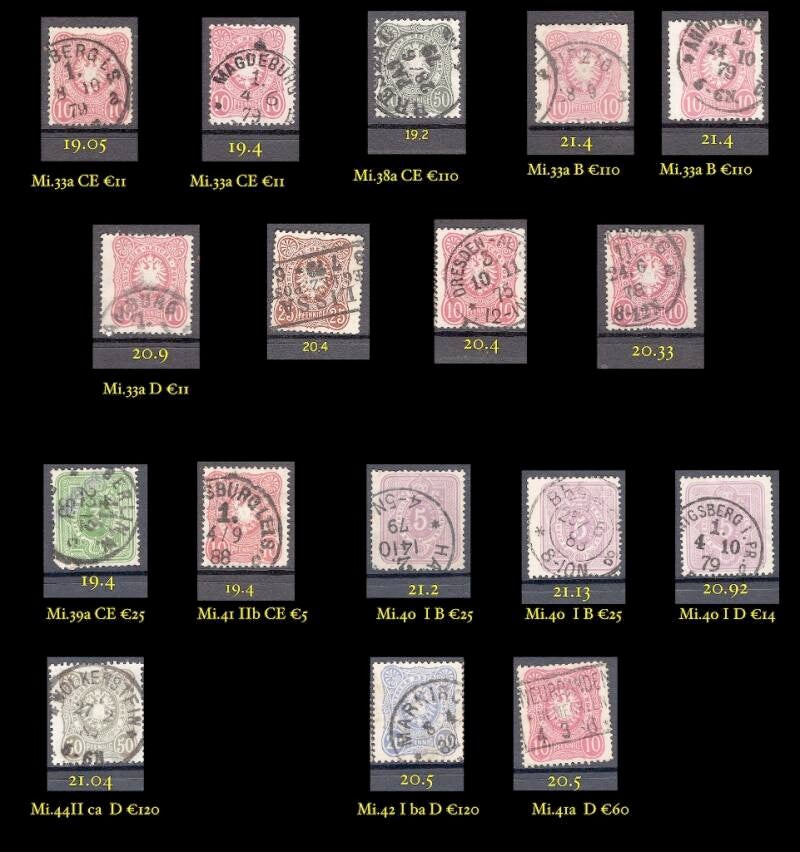
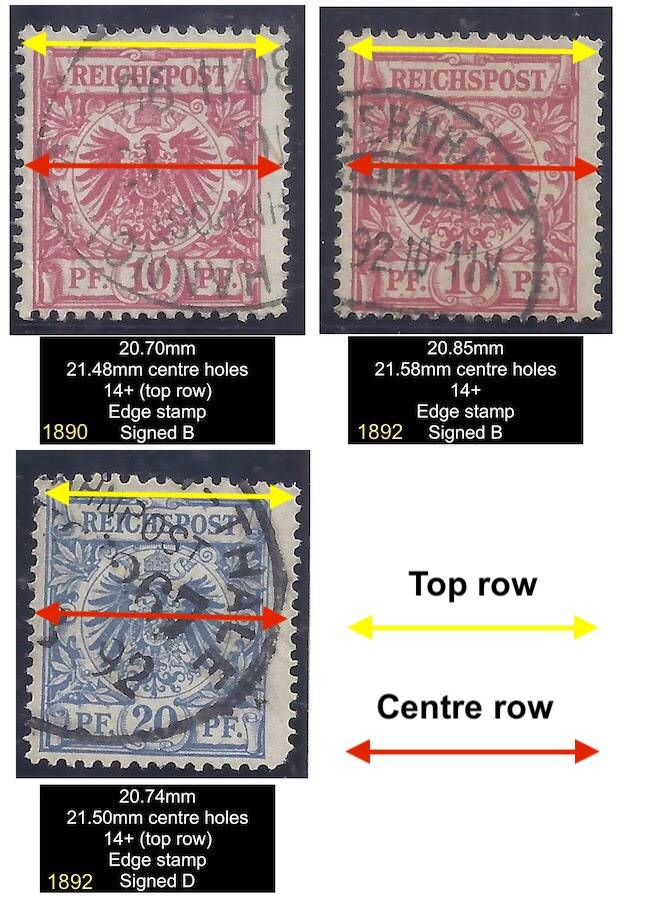
Here are, some later stamps, proofed and measured by me. along top row and centre row perforation to perforation.
These are signed.
Note that there is variation from the top to centre measurements ilustrating another complication in assessing these later perforated stamps.
Likely all three are ´B` with the much higher CVs.All three pane edge stamps.
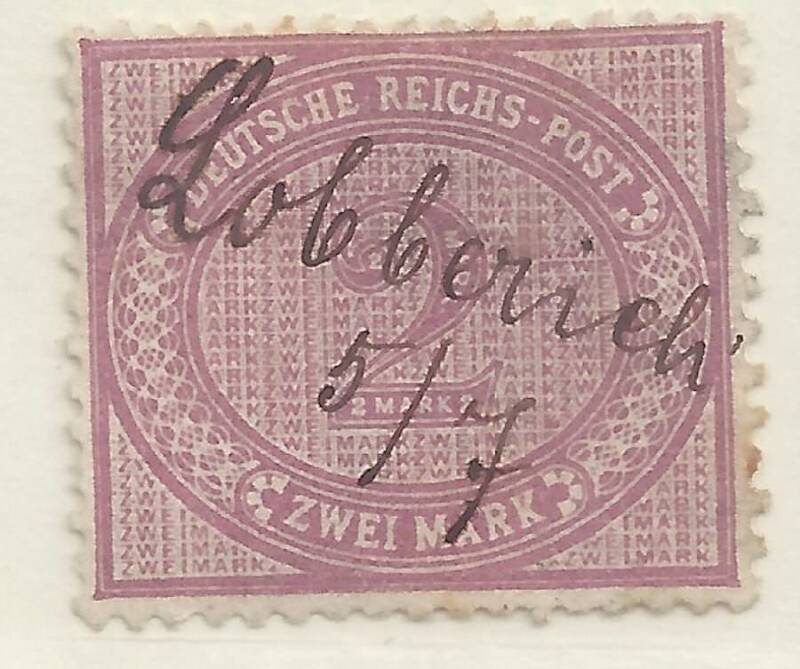
Mi.37.
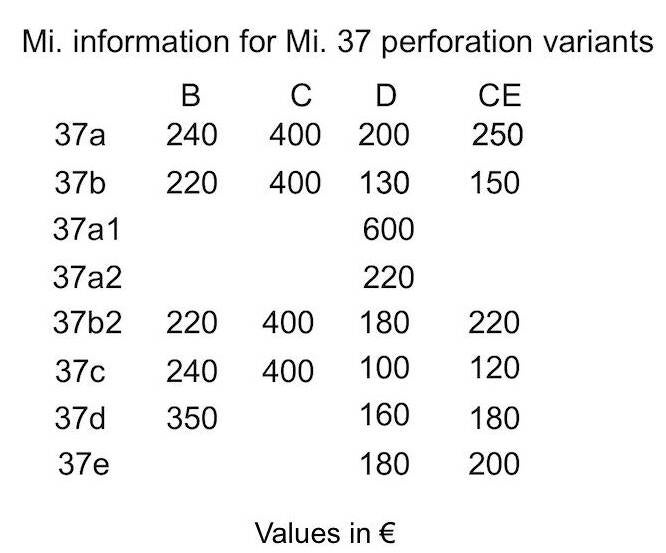
In this case the stamps have a different orientation and are judged as taller or shorter using the perforations on left and right to assess B, C, D and CE. The variants only occur up to 1892. Michel Table data shown on right.
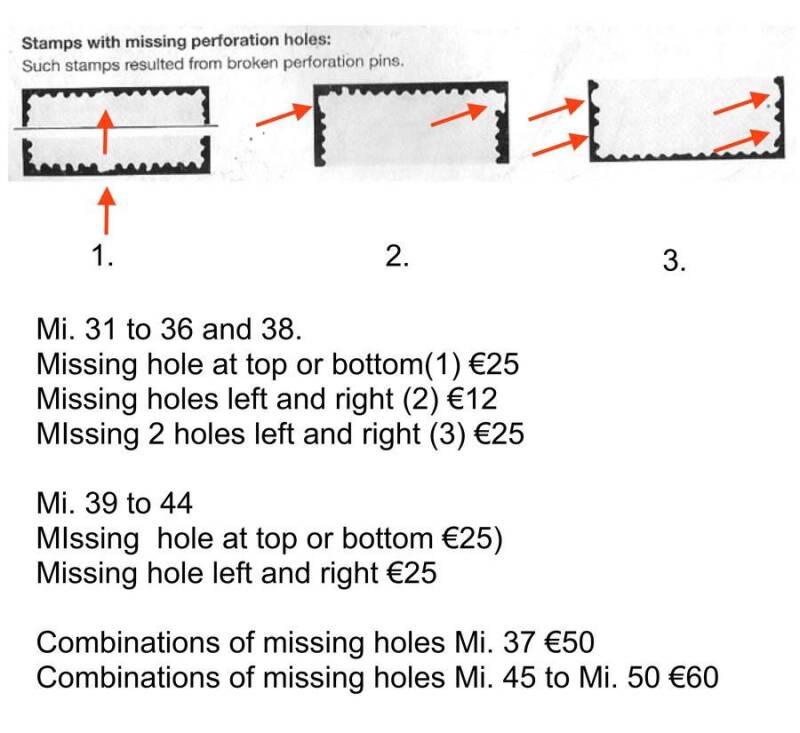
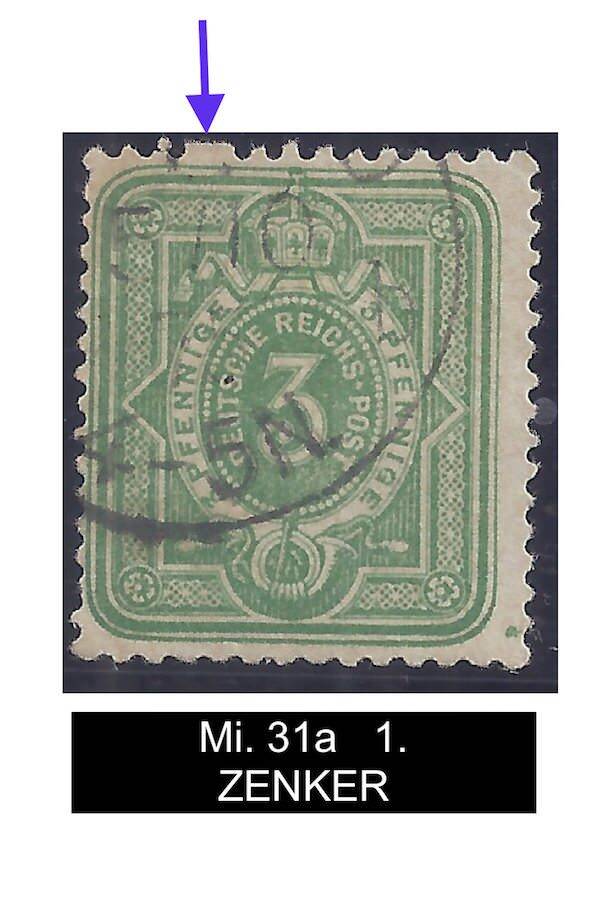
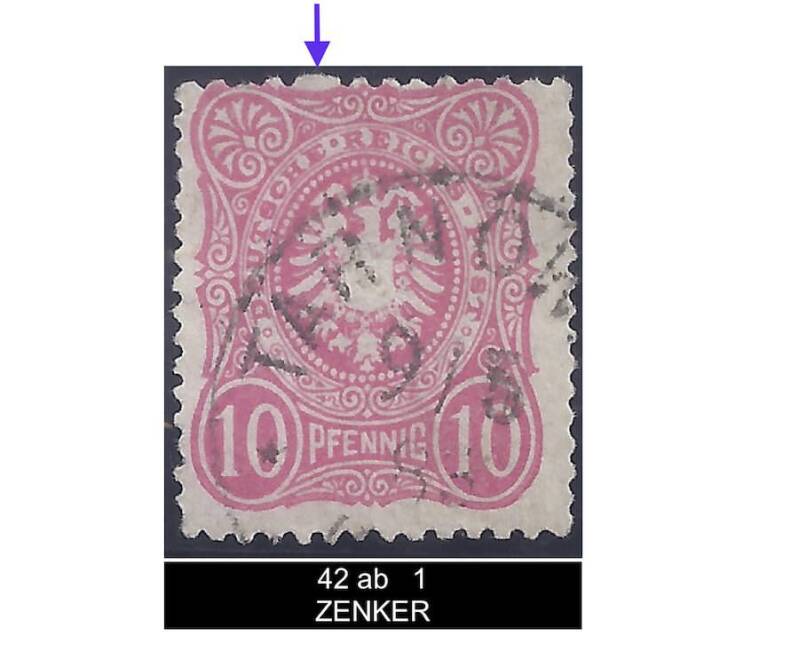
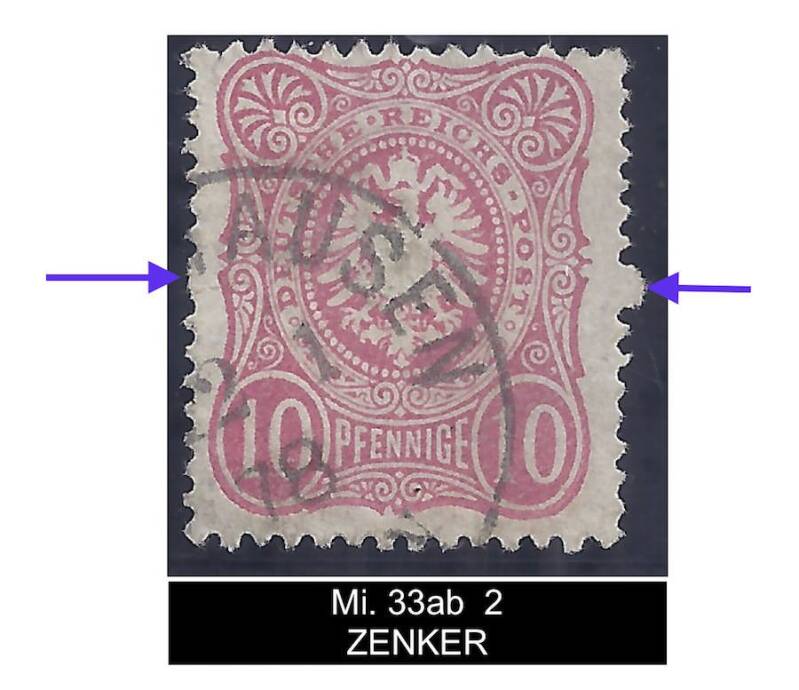
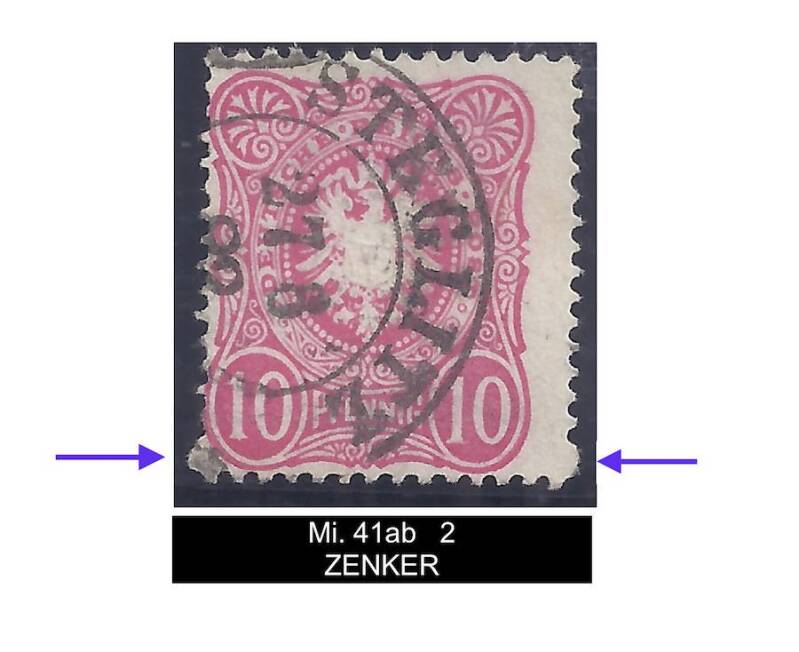
Stamps with missing perforation holes
Another area where stamps are missed on casual inspection.
Michel table explanation is below. Increases in CV over stock stamp are sow.
Examples I have found.

Examine your albums, join Stampboards, and get in touch
Now is the perfect moment to take a magnifying glass to your own German binders and search for overlooked varieties, paper differences, and scarce plate flaws. To delve even deeper into detailed study sheets, high-resolution scans, and ongoing discussions, visit and join the friendly global community at stampboards.com, where I frequently publish extensive research on German and British specialties. If you have questions about specific flaws, need help identifying difficult German shades, or want to discuss rare varieties, reach out anytime at jrcrowther@hotmail.com